
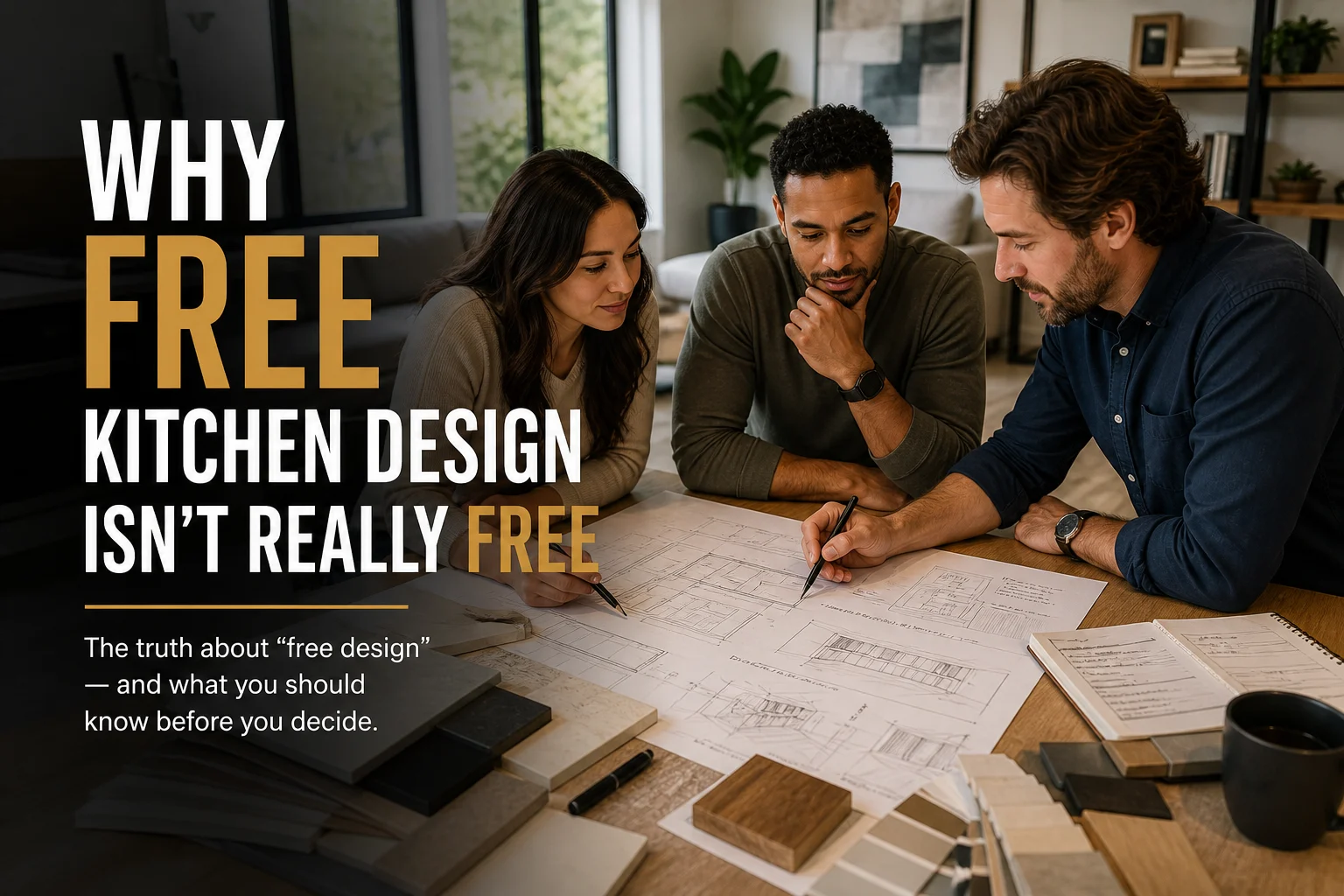
Why is someone willing to spend that kind of time working on your space for free?
Free sounds good. Everyone likes free. You walk into a showroom and they tell you they’ll design your kitchen at no cost — lay it out, pick cabinets, give you a plan — all without charging you. On the surface, it feels like progress. Like you’re getting somewhere without committing to anything.
But there’s a question most people don’t stop to ask.
Why would someone actually do all of that for free?
Why take the time to come out to your home, walk the space with you, take measurements, understand what you’re trying to accomplish — and then go back and build out a plan?
That’s real time and real effort.
And when you see it that way, the answer becomes clearer.
Because in many cases, the design isn’t really the end product — the sale is. The design is what moves you toward that decision, and once that time is invested, the expectation is that it leads somewhere — usually toward a yes. So naturally, the process begins to lean in that direction, toward getting you to commit, and then figuring out how to make everything else work around that.
But the moment you step outside of that… that’s where things start to change.
Now, to be fair, there are situations where that kind of “free design” can work just fine. If your kitchen is simple, nothing is moving, and you’re keeping everything in place while just updating what’s already there — same layout, same footprint — then a quick plan can get you where you need to go. At that point, you’re not really redesigning the space, you’re refreshing it.
But the moment you step outside of that, everything changes. Because now you’re no longer just selecting finishes — you’re solving a space. You’re trying to figure out how it should actually function, whether the layout needs to shift, whether something should open up, or how to deal with areas that never really made sense in the first place.
That kind of thinking doesn’t happen quickly, and it doesn’t happen well when it’s tied to a sales outcome. It requires stepping back, understanding how you live, and aligning that with what the space can realistically support. That’s where real design begins, and that’s the part that most people unintentionally skip.
This is where most people don’t realize the shift that’s happening.
This is also the point where the process quietly shifts, even if you don’t realize it. Up until then, everything feels easy. You’re looking, comparing, reacting to what you see. But the moment the space actually needs to be understood — not just filled — the decisions start to carry weight, and the order in which they’re made begins to matter.
If those decisions are made too early, everything that follows starts working around them. The layout adapts to selections instead of the other way around, and that’s where things begin to drift. Nothing dramatic happens all at once. It’s subtle. A compromise here, a small adjustment there, and before you know it, you’re working with something that functions well enough — but never really feels right.
It looks clean on paper. It feels like progress in the moment. But it’s not actually solving the problem that got you there in the first place.
And that’s usually where people get stuck.
Because what ends up getting built is something that moves the process forward quickly, not necessarily something that was fully thought through.
And if you’re about to invest serious money into your home — $40,000, $50,000, $60,000 or more — “good enough” isn’t really the goal. You’re not doing this just to replace cabinets. You’re doing it because something isn’t working, and you want it to work better.
That requires time. It requires clarity. It requires someone to actually think through how the space should function, what needs to change and what shouldn’t, where the real value is, and where money should — and should not — be spent. Because everything that comes after — cabinetry, construction, finishes — depends entirely on that first step being right.
Garbage in… garbage out.
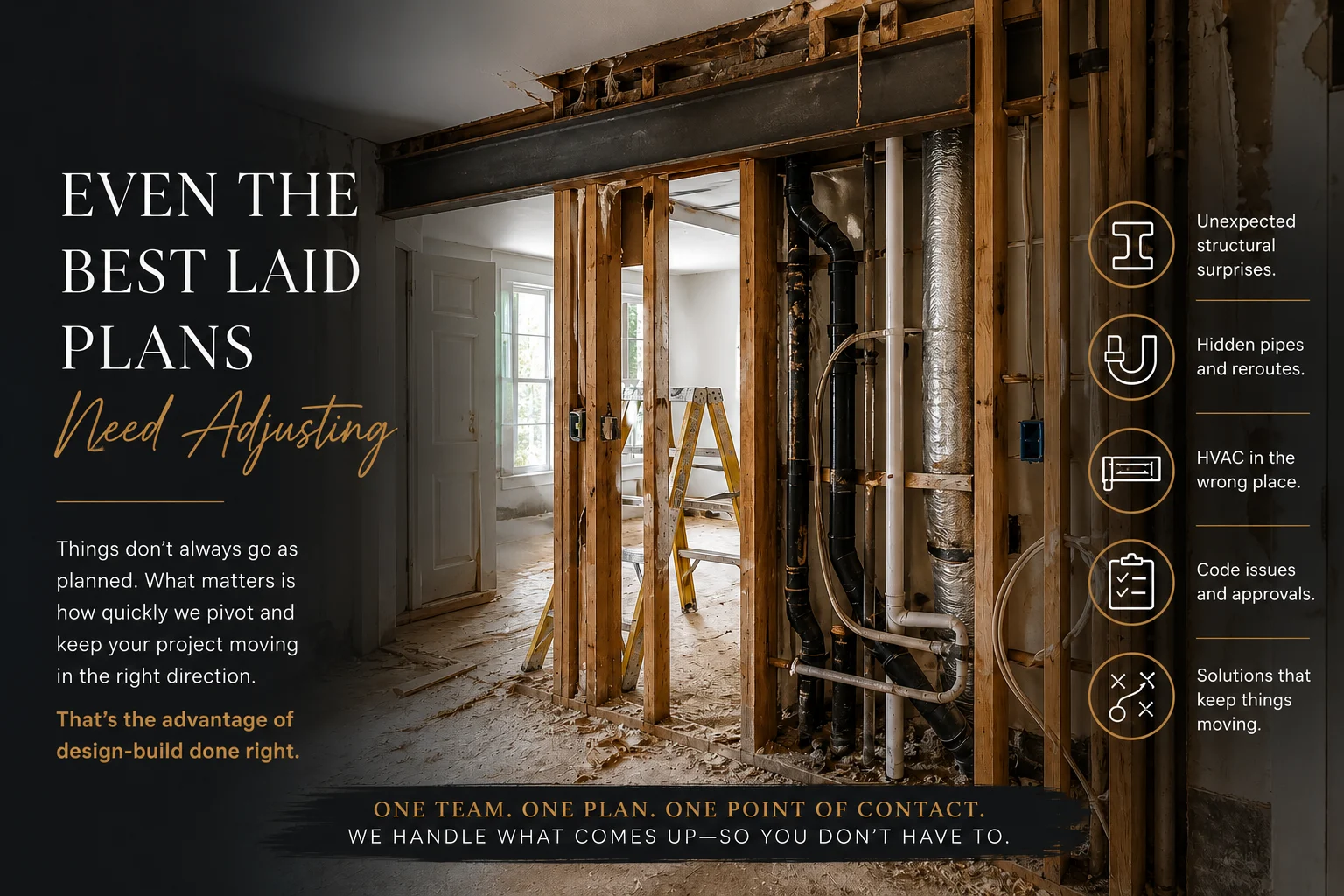
If that first step is rushed, everything downstream is working off a weak foundation. That’s where you start seeing changes during construction, costs creeping up, and things not landing the way you expected. Not because anyone necessarily did something wrong, but because the thinking at the beginning didn’t go deep enough.
So when you hear “free design,” it’s important to understand what it actually is. It’s not free thinking. It’s part of a sales process. And that doesn’t make it wrong — it just means you need to be aware of what’s driving it.
And this is exactly why we separate our process.
That’s exactly why we separate our process. Design comes first, on its own, without being tied to the build. There’s a retainer, and with that comes something most people don’t realize they need — space to think clearly without pressure.
There’s no commitment to move forward, no push to make decisions too early, and no need to force the project into something it’s not yet ready to be. Instead, we slow it down and focus on getting the layout right, understanding how the space should function, and building a plan that actually makes sense for how you live.
Once that’s locked in, then we can talk about cost. At that point, you’re not reacting to selections or trying to make numbers fit a half-formed idea. You’re pricing something real — something that’s already been properly thought through. And from there, you have a choice. You can move forward with us to build it, or you can take that design and go in another direction.
Either way, the pressure is off.
Most projects don’t run into problems because of the finishes that were chosen. They run into problems because the thinking at the beginning never went deep enough, and by the time that becomes clear, the project is already in motion.
That’s the difference. That’s why the first step matters more than anything that comes after. When the design is right, everything else becomes a decision — not a gamble.
If you’re thinking about remodeling and want to understand what your space can actually do before anything gets locked in, we can walk it with you and figure it out properly.
Schedule Your Consultation
📞 914-888-7668