

“Cabinetry is engineering before it is style.”
— RAJ KITCHEN & BATH
Kitchen Cabinets Buying Guide: How Professionals Evaluate Quality
WHAT'S COVERED ON THIS PAGE
PILLAR 1 — CONSTRUCTION
PILLAR 2 — HARDWARE
PILLAR 3 — CABINET LEVELS
PILLAR 4 — FINISH & STYLE
Kitchen cabinets determine how a renovation performs long after installation is complete. Beyond door style and finish, professionals evaluate box construction, materials, joinery, and hardware systems to ensure alignment, durability, and smooth operation for years of daily use. Understanding these fundamentals helps homeowners make informed decisions before orders are placed and options become limited.
Choosing kitchen cabinets involves more than selecting a door style. Long-term performance depends on how the cabinet box is engineered, how materials behave under load, and how hardware systems function through years of daily use.
Kitchen cabinets are not decorative panels mounted to a wall. They are structural storage systems engineered to carry weight, resist moisture, tolerate seasonal movement, and maintain alignment under daily use. That is what they are first. Style, color, and finish come after.
Most homeowners begin with the door. They choose a profile they like — shaker, slab, inset — and assume the rest follows. Professionals evaluate cabinetry differently. We start with the box.
Understanding the Box Architecture
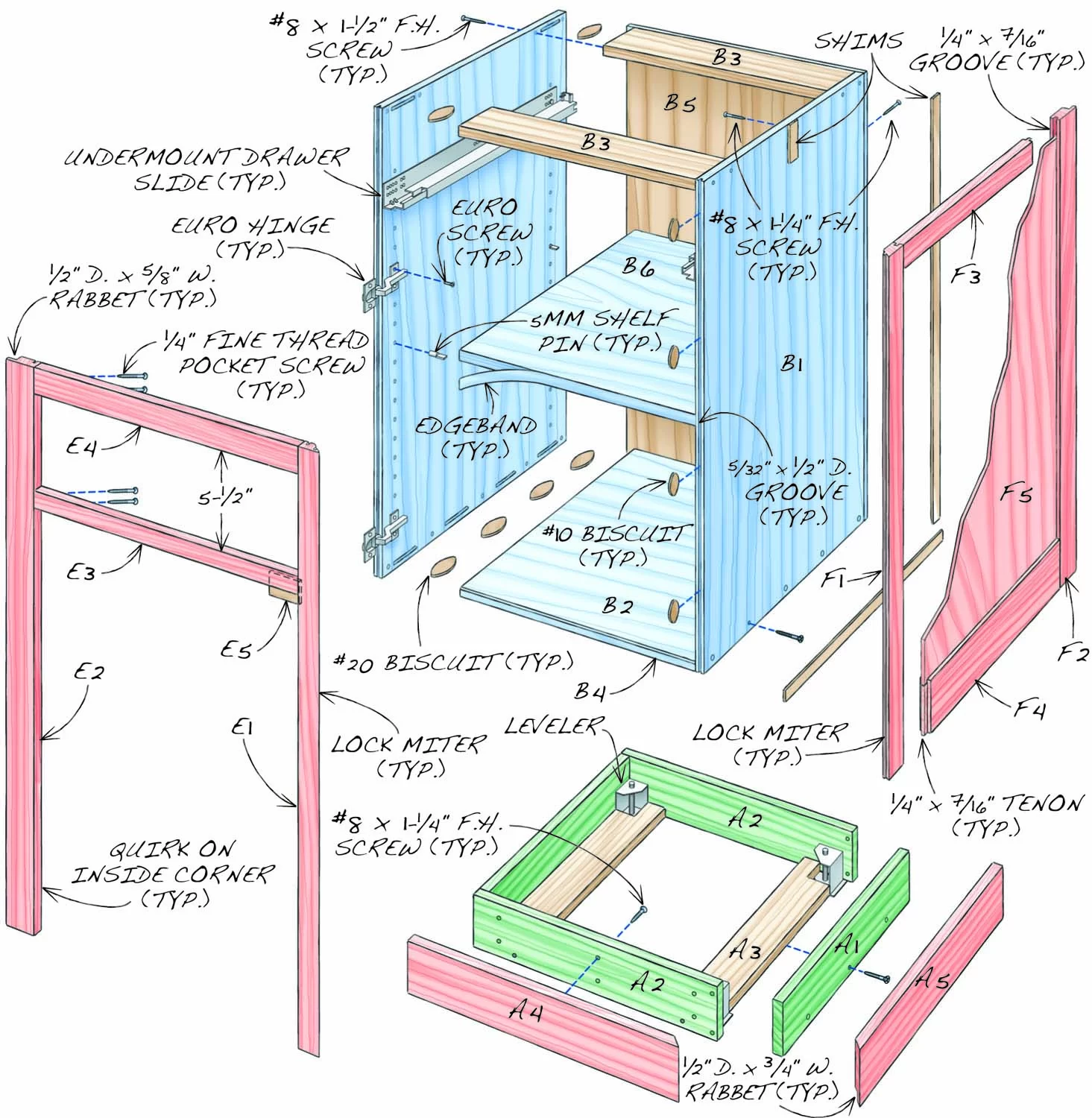
Understanding how a cabinet box is built explains why some kitchens last decades and others fail early.
Before door style is ever discussed, the structure behind it must be understood.
Professionals read cabinetry by its framework.
We look at how the door relates to the box, how weight is carried, and how movement will be managed through years of use.
Is the system frameless and engineered for full overlay?
Is there a face frame introducing reveal and tolerance?
Is the design asking the door to sit inset, where precision becomes visible in every margin?
Once configuration is clear, material decisions follow.
Panel thickness.
Joinery method.
Back construction.
Fastening strategy.
These are the choices that determine whether cabinetry holds alignment under countertop load, seasonal change, and daily operation. And we still have not reached the door.
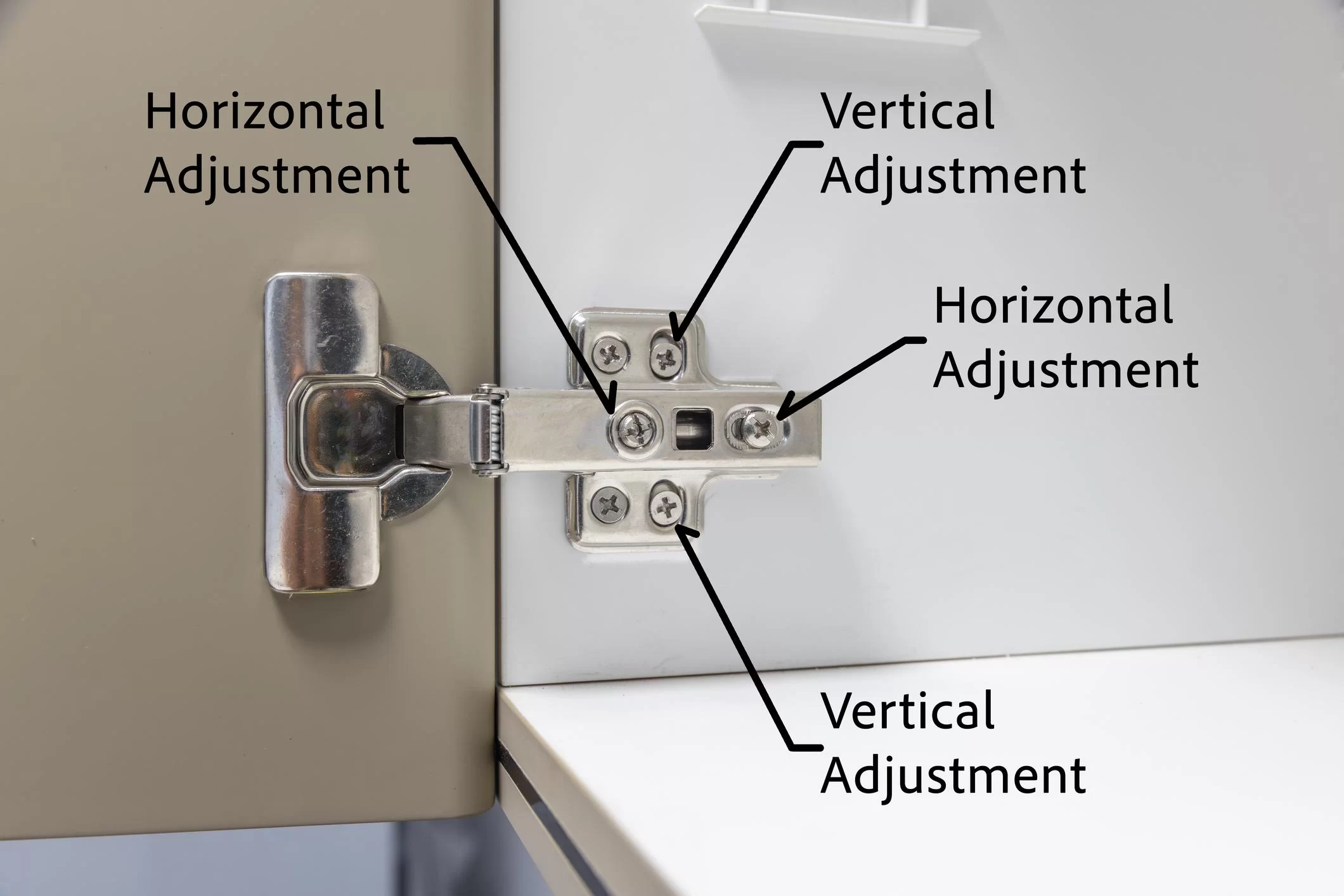
The fourth evaluation layer is internal mechanics — the drawer system and hardware. We inspect the drawer box construction. Is it dovetailed or stapled? Solid wood or composite? Is the drawer bottom fully captured in a dado, or simply pinned beneath the box? What slide system is used? Standard close or soft-close? Undermount full-extension slides or side-mount tracks? What is the weight rating? Are the hinges adjustable in two directions — or six? Are they premium systems such as Blum or Salice, or generic hardware? Every one of these details affects performance, all of this is evaluated before style is even considered. Cabinetry is a structural decision first — an aesthetic decision second.
We have a lot to unpack. Let’s begin.
1. Frameless (Full Overlay) Construction
Before evaluating materials, hardware, or finish quality, the first question is structural configuration. The configuration determines how the cabinet is built, how doors interface with the box, how load is distributed, and how the system behaves over time.
There are four primary structural approaches used in residential kitchens.
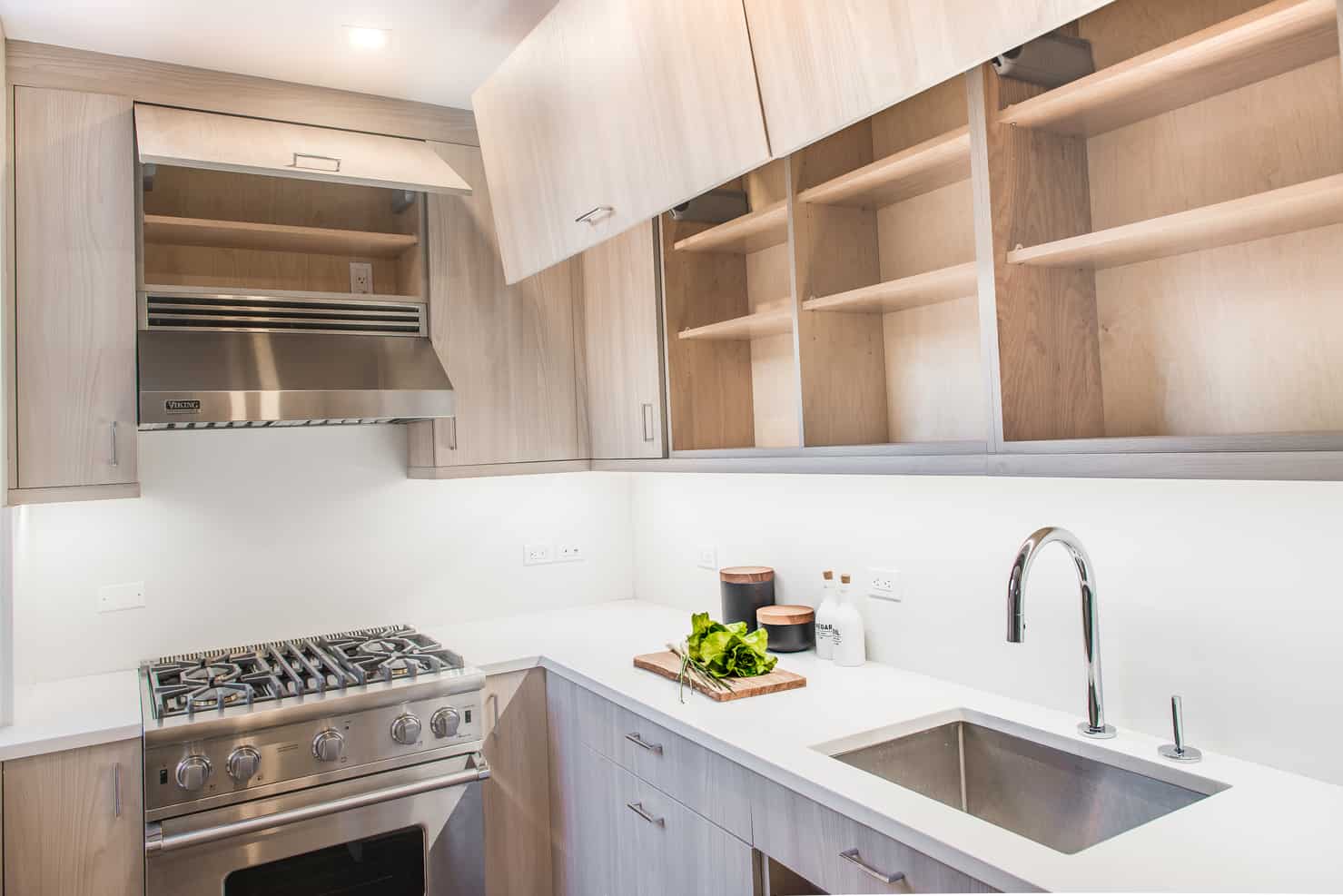
Often referred to as European-style cabinetry, frameless systems eliminate the front face frame. Doors and drawers attach directly to the cabinet box.
This approach offers wider drawer openings, increased interior access, and clean, modern lines with minimal obstruction at the front.
Because the box carries the load directly, frameless cabinetry demands precise manufacturing and accurate installation. Any variance in wall plumb or floor level transfers immediately into door reveals.
Frameless construction is efficient — but highly dependent on precision.
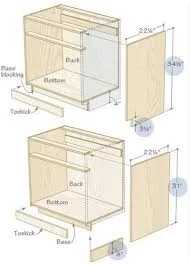
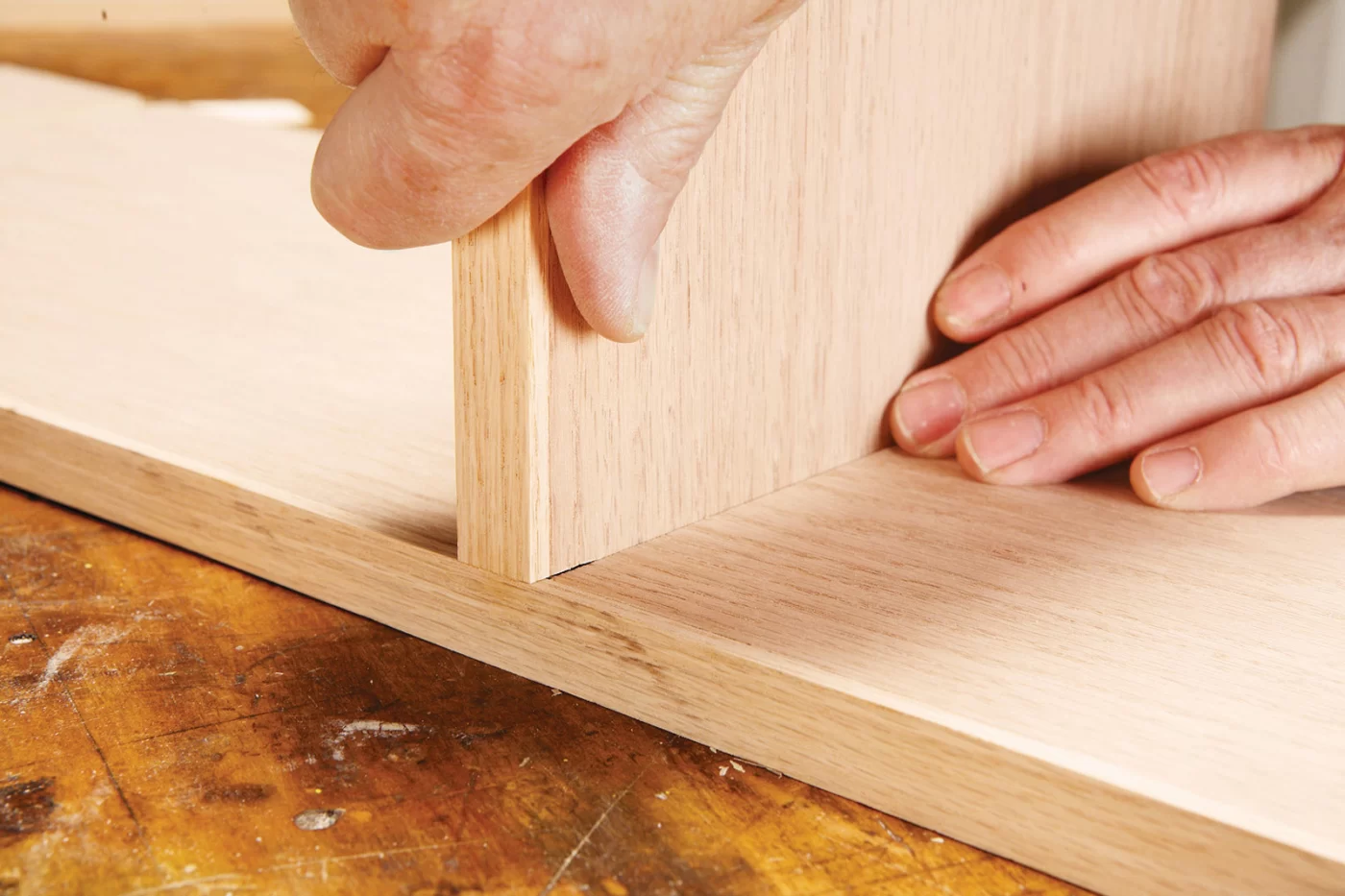
Whenever possible, we prefer to see these boxes built on a plywood infrastructure rather than particle board. Hinges mounted directly into solid material hold up better over time.
Another important consideration is exposed sides. Since the cabinet side is the box itself, it must arrive properly finished or be planned for with skins or applied panels. When this step is overlooked, installers are left solving cosmetic issues in the field.
Frameless has its place. It performs beautifully in contemporary designs where alignment, flat planes, and minimalism are the priority.
2. Face Frame Construction
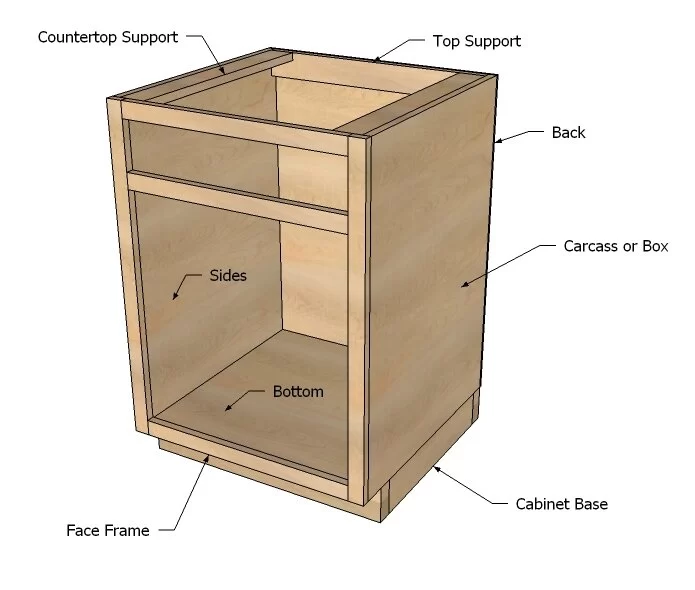
In this system, a solid wood frame is attached to the front of the cabinet box. Doors and drawers mount to this frame rather than directly to the box itself. This is completely different construction from a frameless cabinet.
Because the frame provides rigidity, the box does not always require 3/4″ plywood sides. You will often see 1/2″ plywood material paired with a 1-1/2″ x 3/4″ hardwood face frame. That shift in engineering opens options for manufacturers and creates design flexibility for the homeowner.
This is where construction and style begin to intersect.
Good construction creates choices later.
Weak construction removes them.
How Face Frame Changes the Design Equation
A face frame cabinet adds frontal strength and helps compensate for minor installation variances. In older homes, where walls are rarely perfect, that forgiveness can be extremely valuable. At the same time, the frame slightly reduces interior access compared to a frameless build. That’s the trade.
From here, doors can be installed in different ways. You can mount them tight so the kitchen visually mimics a frameless look, or you can use a traditional overlay — often around 1/2″ — where a reveal appears between doors. Either approach can work. The difference is the result you want to achieve.
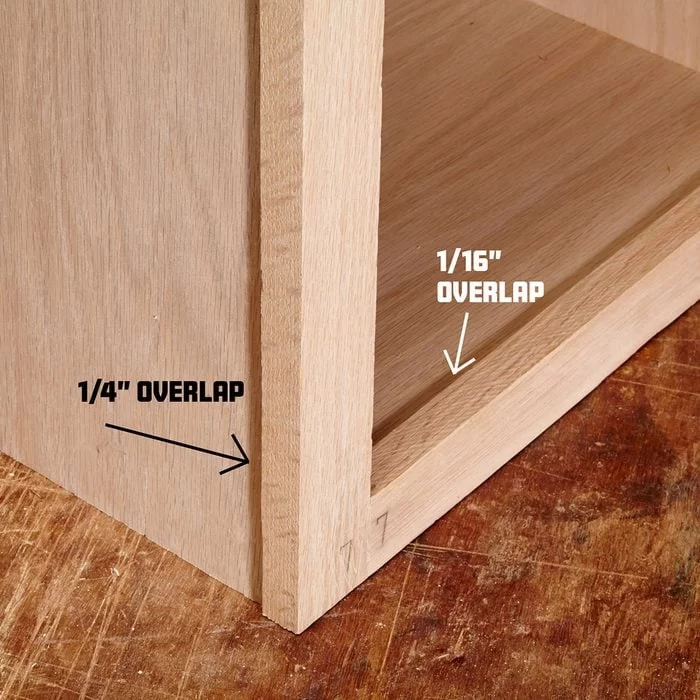
Standard construction usually leaves about a 1/4″ exposure at the cabinet sides. What happens next depends on the manufacturer and on how the kitchen is being designed.
You might finish with a skin panel, apply a decorative end, or engineer a fully integrated end that becomes part of the cabinetry system.
Not every line can support every option. Some of these upgrades are simply not available in stock cabinetry.
When done correctly, face frame construction is not better or worse than frameless. It is a design decision guided by architecture, budget, and the final appearance you are after.
The right answer is rarely universal it is specific to the house.
3. Inset Construction
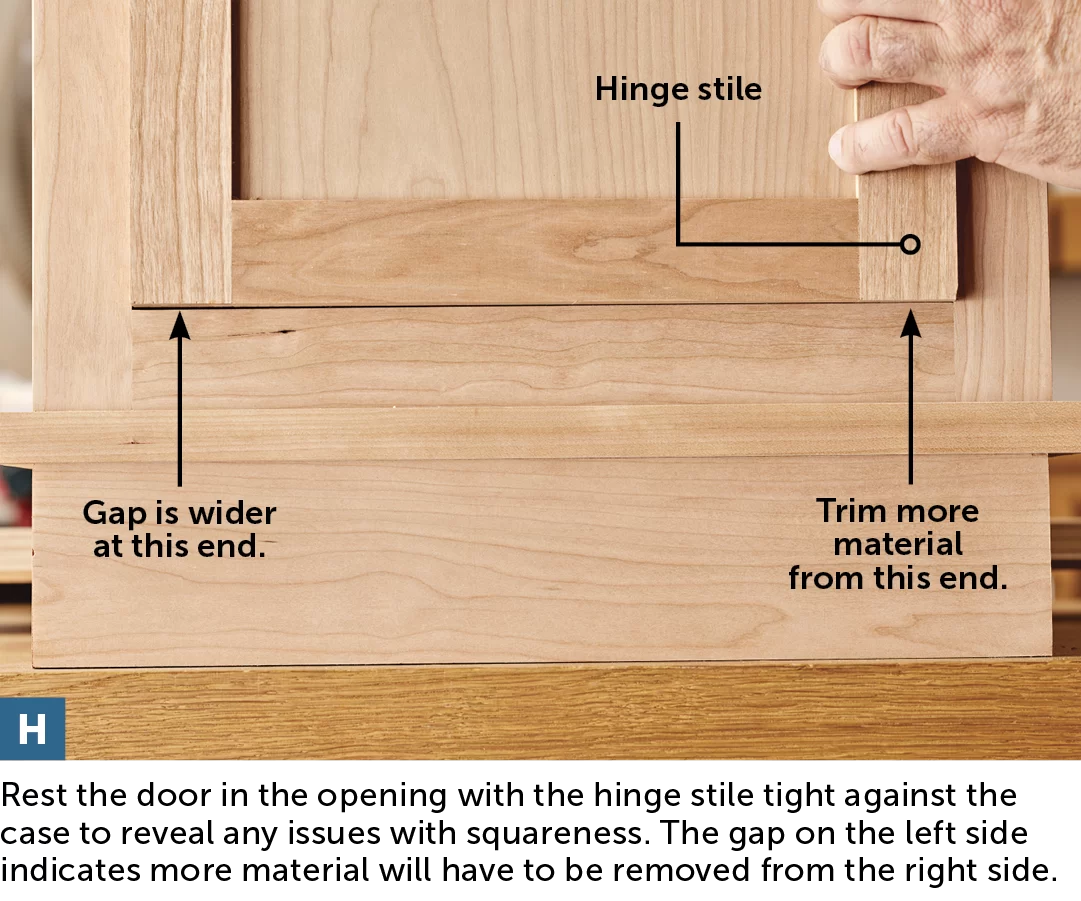
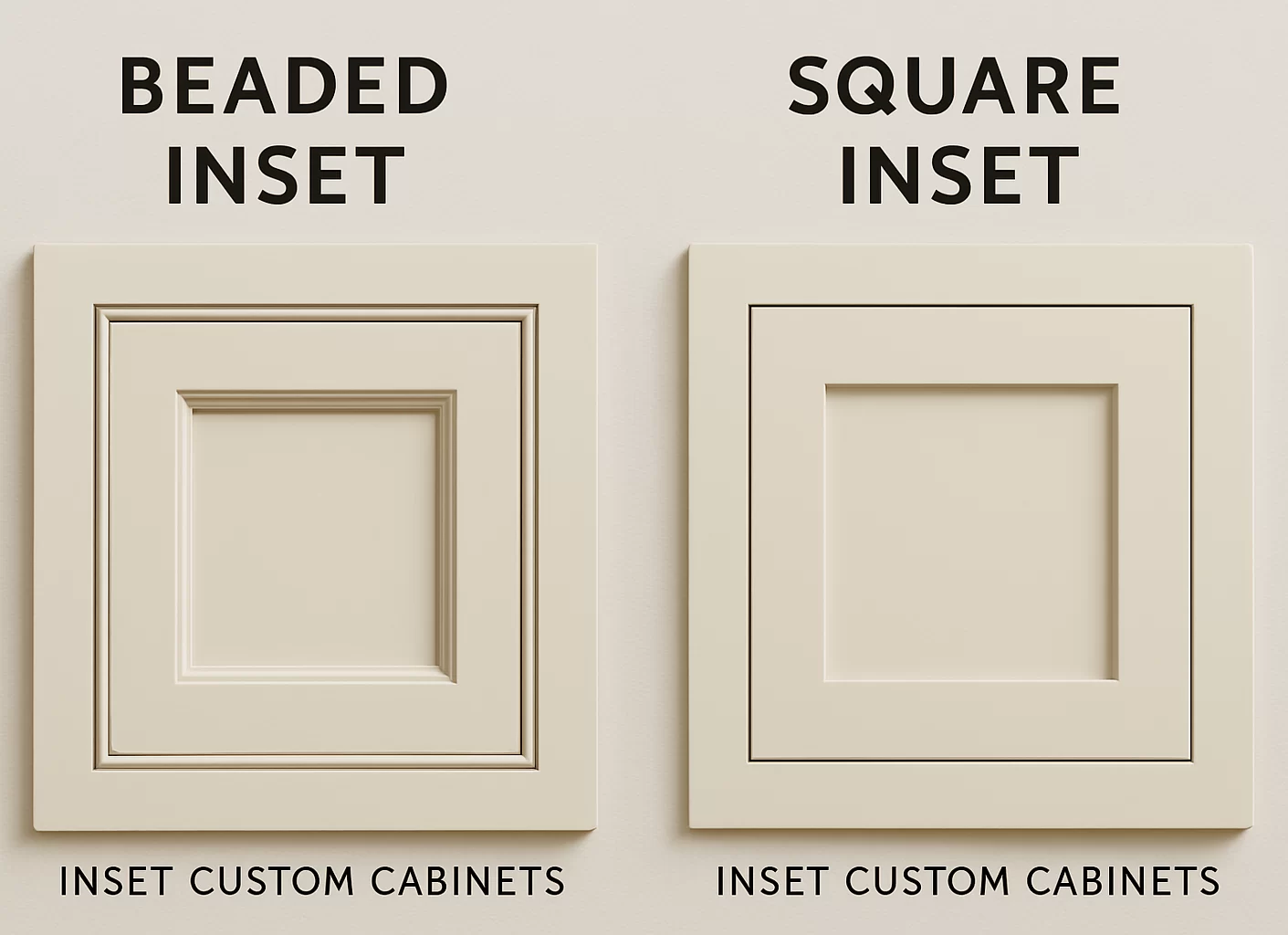
This is where things move into a different category. Inset cabinetry is built on the same face frame concept, but now the doors and drawers sit inside the frame rather than on top of it. Overlay rests over the frame. Inset fits within it. It sounds simple. It is not. Boxes must be built more precisely. Wall cabinets often need additional depth to accept the door while still functioning properly. Tolerances become tighter, and installation demands far more discipline.
Because of this, many manufacturers — especially stock lines — avoid offering true inset. When you see it executed well, it is exceptional. When it is not, no amount of field adjustment can hide the problems. Inset kitchens are classic, distinct, and timeless. They are also not right for every home and certainly not every budget.
What Professionals Look For
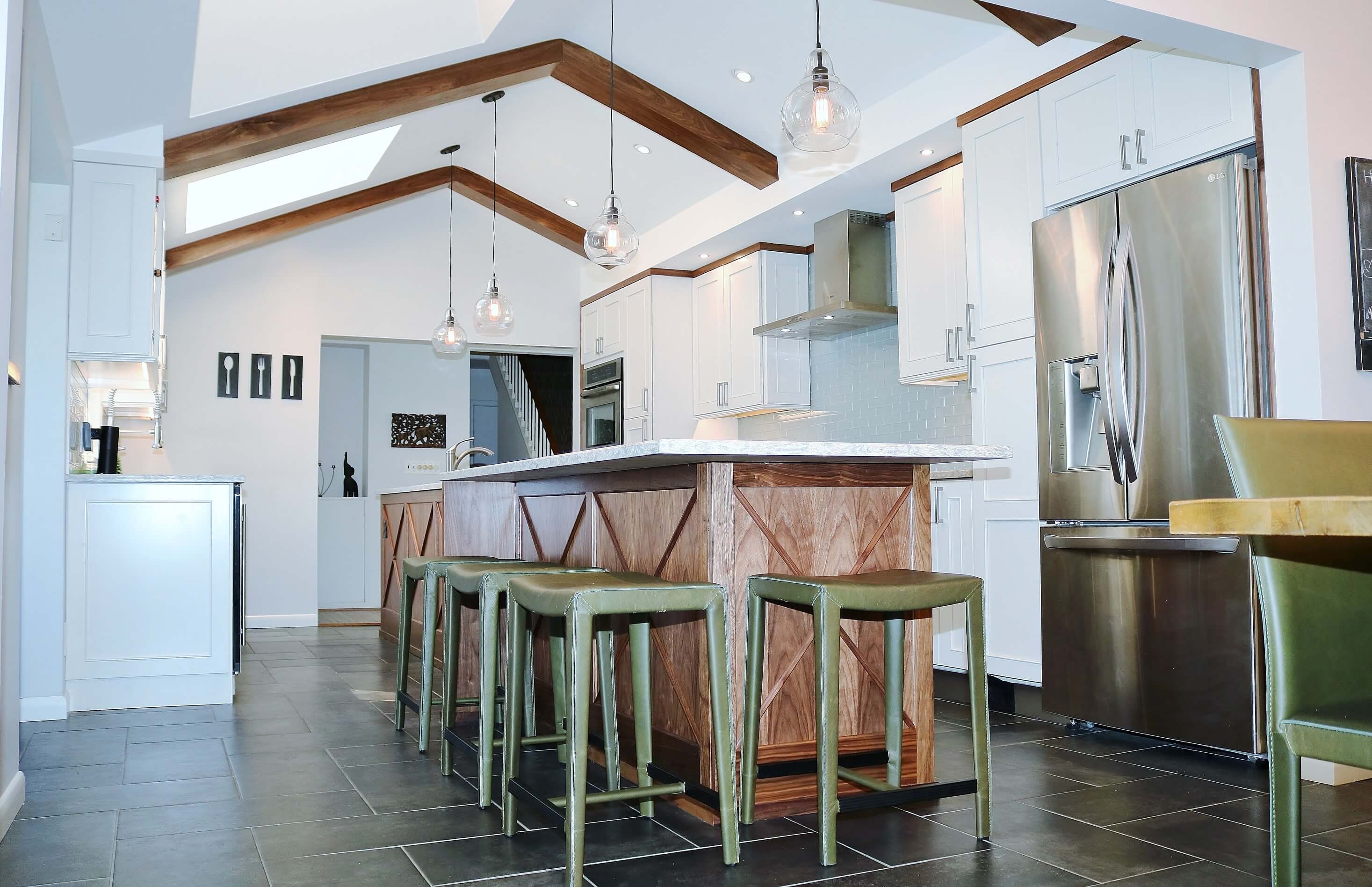
Inset cabinetry begins with a strong foundation. The box has to be right before anything else can happen. From there, it has the potential to rise to an entirely different level. The goal of inset is to deliver a classical, evergreen result — a kitchen that can feel appropriate a hundred years from now when it is maintained properly. But achieving that outcome is not automatic.
When I walk into an inset installation, fit and finish is everything. Yet if the design was not solved correctly from the start, no amount of field adjustment can make it feel polished later. One of the first things I study is how the boxes were meant to come together. Were they ordered and engineered to merge cleanly?
Or is alignment being forced in the field because the system couldn’t support it from the factory? You see the answer immediately — especially along the base cabinets.
Structural Configuration
Sides & Integration
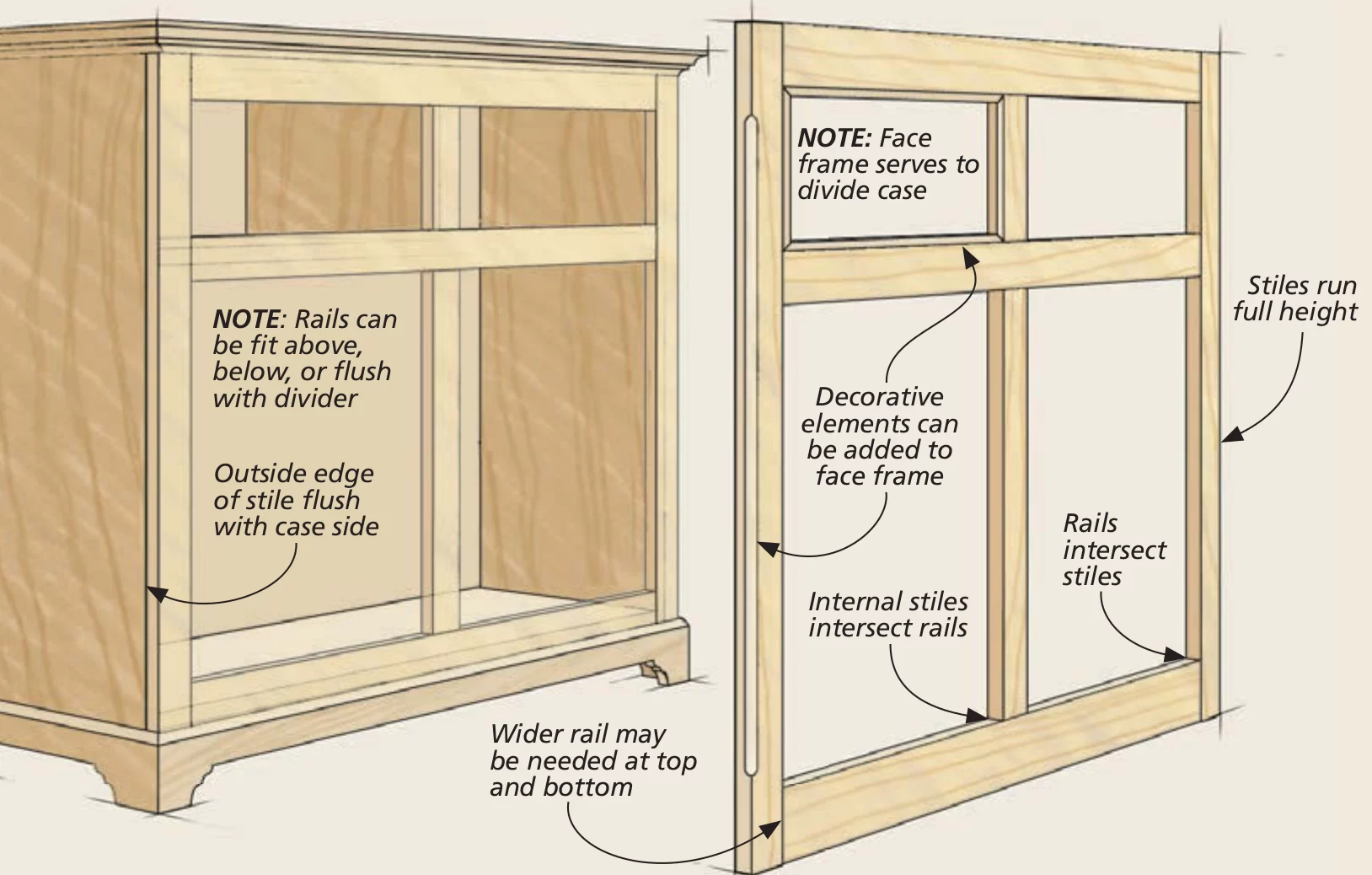
From there, I move to the sides.
A simple flush end can work. But if you want a premium result, serious design effort has to go into the end treatment. That decision alone can make or break the entire room.
Then I look at the appliance panels. They must tie into the cabinetry as if they were always part of the structure. Nothing should feel applied or forced.
That 1-1/2″ frame becomes the reference point for rhythm, alignment, and consistency across the entire run.

Where Mistakes Show
Inset magnifies transitions. It highlights inconsistencies. It exposes hesitation.
What might pass in another cabinet style becomes obvious here.
Choosing inset boxes is not enough.
The real skill is turning them into a statement.
When I look up.
How does the crown begin at the top of the cabinet?
Is it beaded or is molding applied to manage the connection?
Is it flush? That can be beautiful, but only when it matches the character of the home and the language of the doors.
Is it offset? Another strong move — when handled with intention.
Each of these approaches can dramatically change the feeling of the kitchen.
Did the designer study how that molding profile relates to the door style and to the surrounding architecture?
Balancing those relationships is difficult, particularly in older houses.
This is where many kitchens lose their refinement.
Following the Lines Down
Now follow those lines downward. How do they terminate at the bottom?
Is the scale correct?
Are moldings being added simply to add them, or are they intersecting rails with intention and control?
Sometimes the most important question is the simplest one:
Should that molding exist in this kitchen at all?
Inset is not about adding more. Inset is about designing correctly.
Because once these decisions are built, they are permanent.
Design Depth
Inset cabinetry allows tremendous design depth.
You can introduce a beaded frame or keep it clean and minimal. You can place a slab drawer beneath a detailed door to create contrast. Hinges can disappear into the background, or they can be expressed intentionally with exposed barrel hinges to bring metal finishes into the overall story.
You may sacrifice soft-close depending on the hinge approach, but in the right home that trade can be exactly what makes the space feel authentic.
The Discipline
Consistency is everything. Inset requires a different mindset. It demands planning, restraint, and discipline. It is often the most expensive cabinetry path, and it also requires the highest level of execution to deliver successfully. This is why inset projects demand deeper planning conversations long before installation begins.
Wondering if inset cabinetry is right for your home? The answer depends on your architecture, budget, and who's executing it.
LET'S FIND OUT TOGETHER →Pillar 2 – Hardware, Movement & Daily Performance
Cabinetry is not static. Doors open, drawers cycle, weight shifts, hinges carry load, and slides absorb impact. Adjustment systems are expected to compensate for seasonal movement as materials expand and contract. This is where quality reveals itself — sometimes immediately, sometimes slowly over time.
A kitchen can appear beautiful on installation day, but if it does not operate correctly, that initial impression fades quickly.
At this stage, the conversation changes. We are no longer judging shape or proportion; we are judging endurance. The real question becomes how the cabinet system will perform after years of cooking, cleaning, loading, unloading, humidity swings, and constant repetition.
Those miles tend to arrive faster than most people expect.
Hinges & Door Control
Hinges may be small, but they do enormous work. They dictate how a door sits, how it returns, how it relates to surrounding fronts, and how adaptable the cabinet will be over time.
Soft-close is common.
Long-term alignment is not.
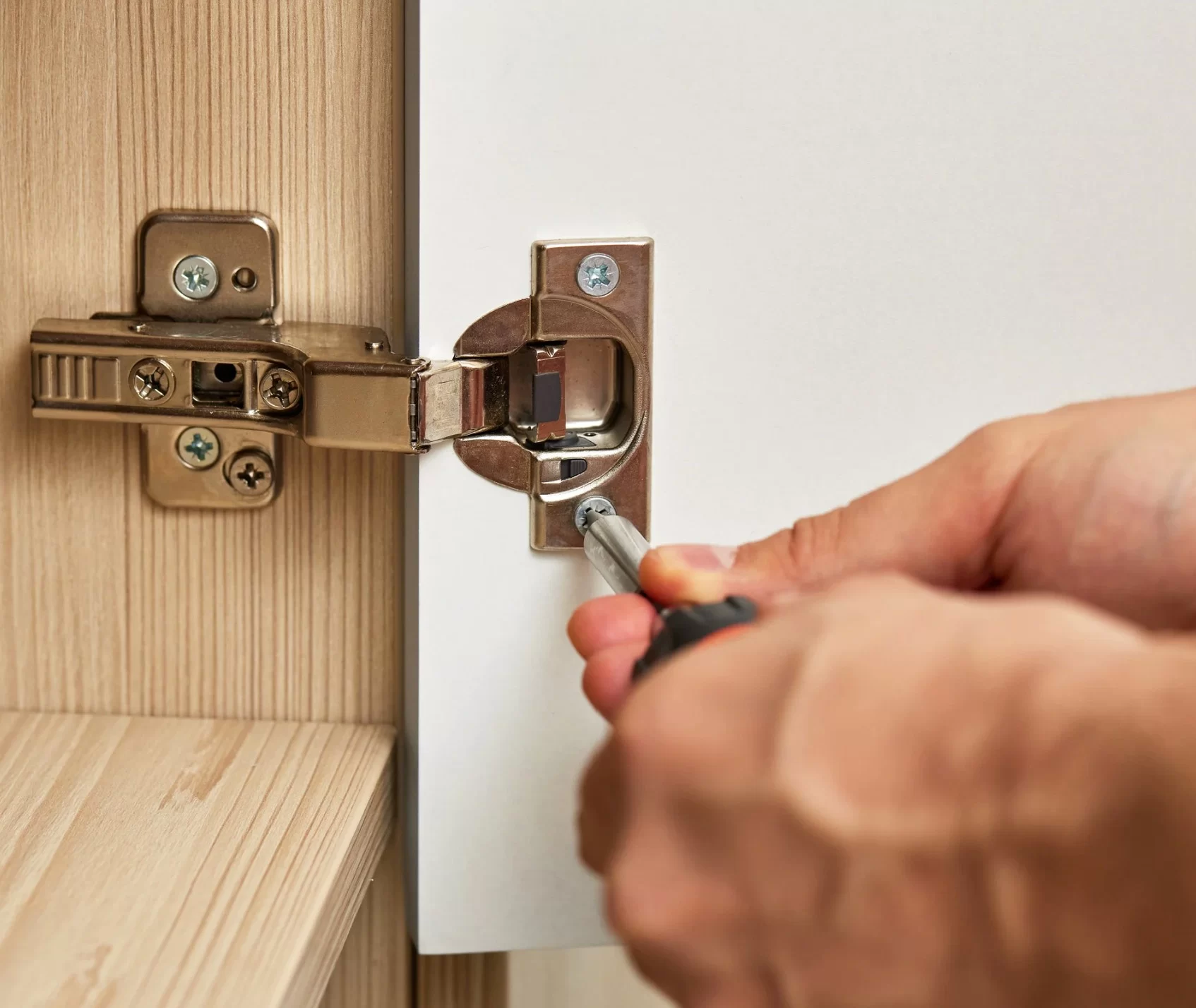
Higher-quality hinges allow precise multi-directional adjustment so doors can be refined as homes settle and materials move with the seasons.
Without that flexibility, small imperfections become permanent.
Adjustments
Adjustments
Interior Mechanisms & Clearances
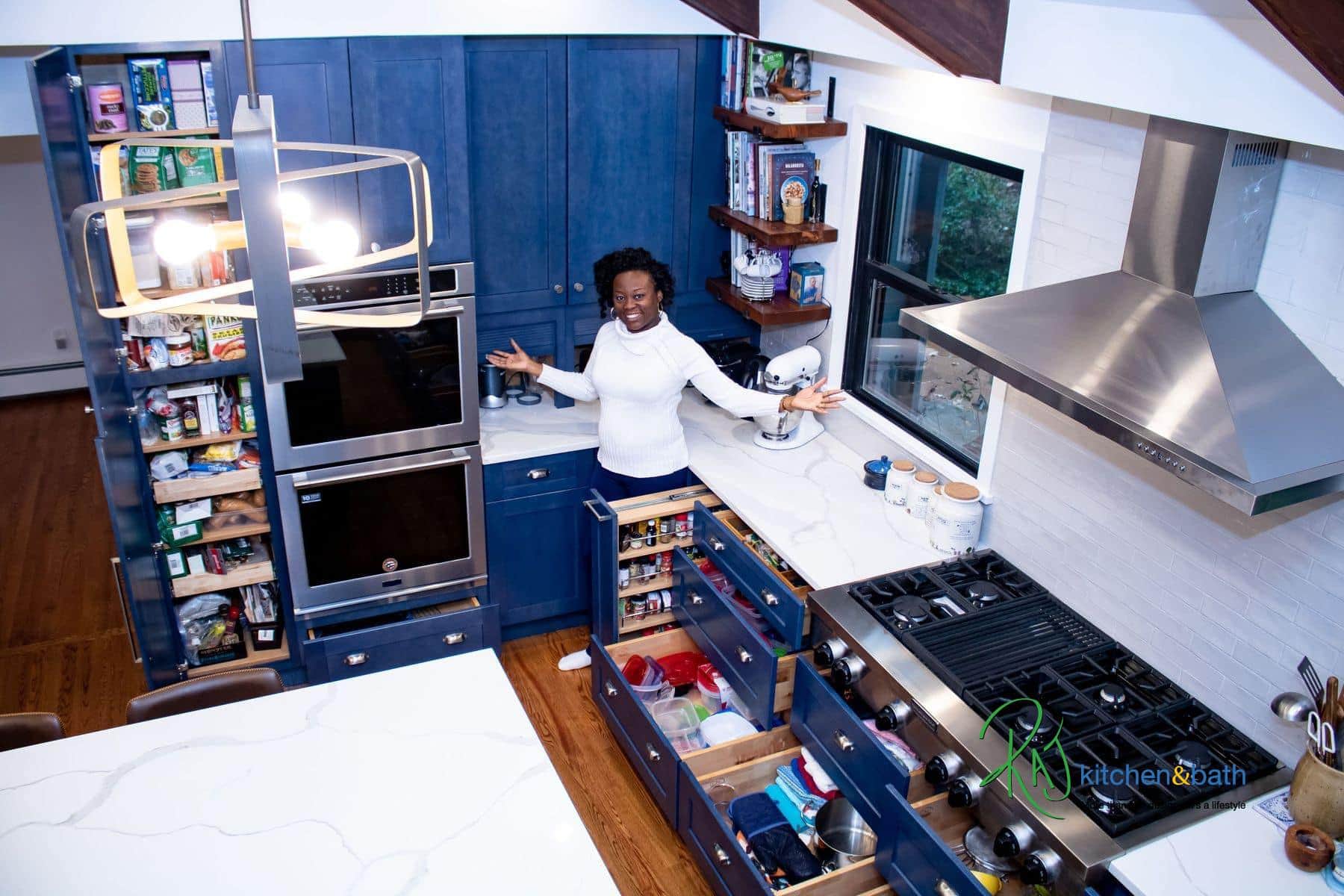
Lift systems, roll-outs, corner hardware, and integrated organizers can transform how a kitchen functions — when they are engineered into the plan with precision.
When they are not, they quietly become the small irritations a homeowner feels every single day.
Clearances must be calculated.
Door paths must operate in harmony.
Appliance projections, handle depth, and user movement all need to be anticipated long before installation begins.
What appears effortless in daily use is almost always the result of deliberate technical planning.
The Reality of Daily Use
A kitchen may be opened and closed fifty to a hundred times a day. Multiply that across years. Hardware determines whether the experience continues to feel tight and intentional or begins to feel worn long before its time. Good mechanics disappear into the background. Poor ones introduce themselves constantly.
Drawer Construction
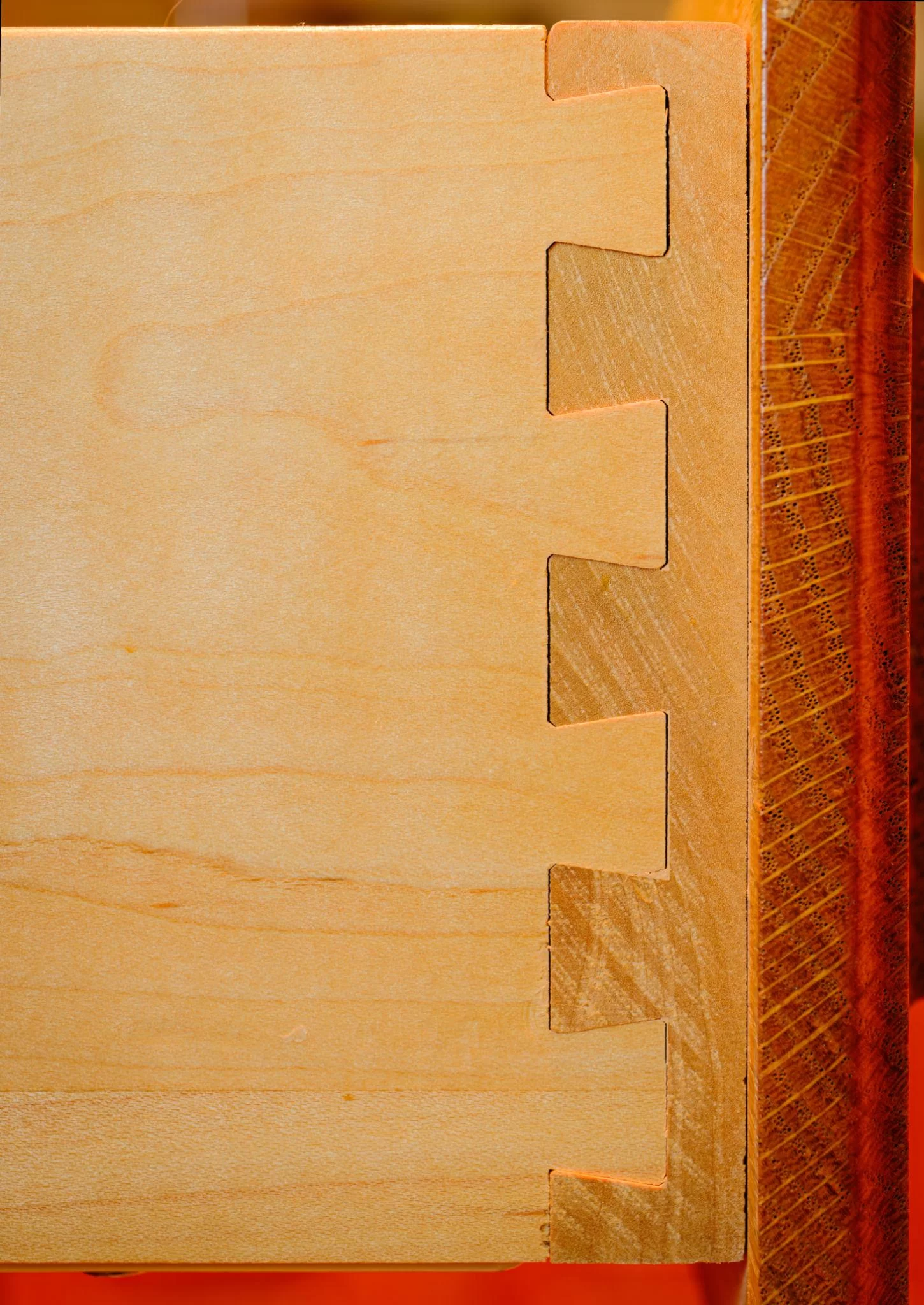
Drawer construction is one of the earliest failure points in lower-tier cabinetry.
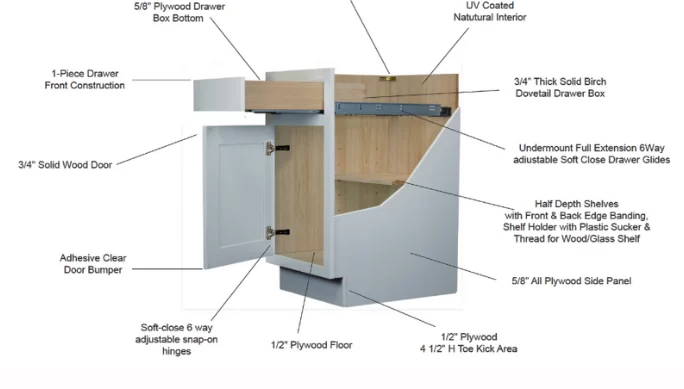
Higher-quality systems typically include dovetail joinery, solid wood drawer boxes, undermount full-extension slides, integrated soft-close, and weight-rated hardware.
Mechanical performance matters more than finish sheen.
Undermount slides also protect against the side-load stress common in high-use kitchens.
How We Approach Specification
Over the years, we have worked with many cabinet manufacturers. Some delivered consistency. Some did not.
Experience has a way of narrowing the field.
Today, we partner with a select group of cabinet makers whose engineering, reliability, and support allow us to stand behind what we install with confidence.
Their systems give us predictable tolerances, dependable hardware performance, and the ability to service and adjust kitchens properly as they age.
That filtering process did not happen in a showroom.
It happened in real homes, over time.
And it protects our clients from discovering limitations after the kitchen is already built.
Because once cabinetry is installed, changing direction is rarely simple.
The right hardware decision starts before the order is placed — not after installation reveals the problem.
SCHEDULE A CONSULTATION →Pillar 3 – Cabinet Levels: Stock vs. Semi-Custom vs. Custom
Once structure and performance are understood, the conversation shifts from how cabinets are built to how they are sourced. Cabinetry exists on a spectrum — from standardized production systems to highly customized fabrication — and each tier carries its own balance of flexibility, lead time, cost, and design control. The question is not which category is “better,” but which category aligns with the space, the expectations, and the scope of the project.
Broadly speaking, cabinetry falls into three primary tiers: Stock, Semi-Custom, and Custom. Each serves a different purpose. Each operates within different constraints. Understanding those distinctions allows homeowners to invest intelligently rather than emotionally.
The most widely available entry point on that spectrum is stock cabinetry.
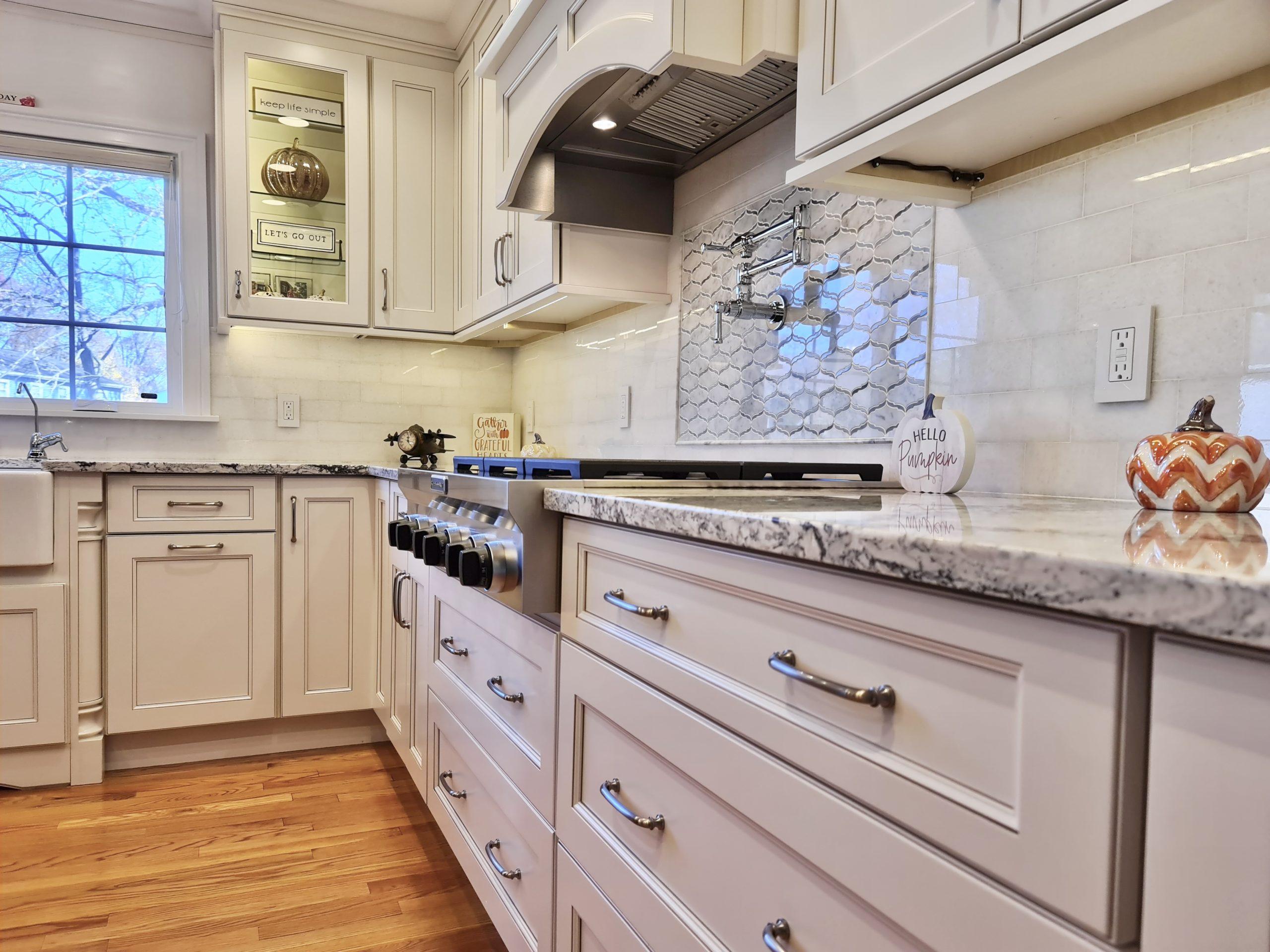
Standard cabinets are manufactured in predetermined sizes, finishes, and configurations, which means what you see in the catalog is largely what you can order. Because production is standardized, pricing can be attractive and lead times are often shorter. That efficiency, however, comes with structure. When dimensions do not align perfectly, fillers are introduced. When a finish is close but not exact, compromise enters the design. And when a modification is required, it may simply not be available.
In the right setting, stock cabinetry can perform very well. But not every space is the right setting. Irregular wall conditions, tight clearances, ceiling height variations, or structural offsets can quickly expose the limitations of a fixed system. Stock does not adapt to a room — the room must adapt to stock.
A standard kitchen
For that reason, success with stock cabinetry depends on disciplined planning. Layout decisions must respect standard increments. Appliance selections must align with available cabinet widths. Design expectations must match manufacturing reality. When those boundaries are understood and honored, stock can deliver efficiency and value. When they are ignored, compromise becomes visible.
Stock performs best when the design respects its limits — and when the space itself allows it.
Semi-Custom Cabinetry
This is where many projects find balance. Semi-custom manufacturers begin with a structured catalog but allow controlled adjustments — height modifications, depth variations, expanded finish options, and upgraded storage accessories. The framework remains factory-driven, yet the design gains meaningful flexibility.
That additional range creates far more opportunity to tailor a kitchen to the room while still benefiting from production efficiency and proven systems. Layout alignment improves. Finish selections broaden. Functional upgrades become more refined.
However, semi-custom is not limitless. Certain ideas will remain outside what the factory can support, and understanding those boundaries early prevents frustration later. Semi-custom expands flexibility — but it does not eliminate constraints. It refines the balance between customization and control.
Custom Cabinetry
Custom cabinetry represents the far end of the spectrum — where fabrication begins with the room rather than a catalog. Dimensions are not limited to preset increments. Heights, depths, and widths are built to suit the architecture. Materials can be selected intentionally. Construction methods can be specified. Design details are resolved at the millwork level rather than adapted from a production template.
This level of control allows the cabinetry to respond directly to ceiling conditions, structural irregularities, appliance integrations, and architectural detailing. Storage solutions can be engineered around use patterns. Proportions can be refined. Sight lines can be corrected. The cabinetry becomes part of the structure of the room rather than an installed system within it.
That flexibility, however, requires clarity and discipline. Custom work demands detailed planning, longer lead times, and greater investment. It offers the highest level of alignment — but it also depends on precise design direction and experienced execution.
Custom cabinetry does not operate within factory boundaries. It operates within design intent.

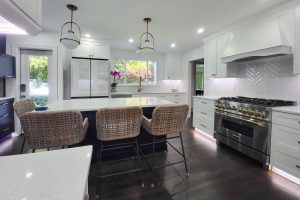
The Professional Responsibility
Our role is not automatically to push every project to the highest tier.
It is to match the cabinet system to the home, the design intent, the performance expectations, and the investment level.
Sometimes Standard/Stock cabinetry is exactly right fit.
Sometimes it’s the semi-custom cabinetry that will deliver the smartest balance.
Sometimes only custom can achieve the vision.
The key is understanding the difference before orders are placed.
Because once manufacturing begins, options narrow quickly.
Matching the system to the project is where experience proves its value.
Comparison Table
| STOCK | SEMI-CUSTOM | CUSTOM | |
|---|---|---|---|
| Sizing | Fixed increments | Adjustable ranges | Built to exact spec |
| Finish Options | Limited | Expanded | Unlimited |
| Lead Time | Short | Medium | Long |
| Best For | Simple layouts | Most projects | Complex & luxury |
| Design Flexibility | Low | High ✓ | Highest ✓ |
| Investment | $ | $$ | $$$ |
Not sure which tier fits your project? That's exactly what our consultation is designed to answer — before any orders are placed.
SCHEDULE A CONSULTATIONWhat Experience Changes
After years in the field, patterns become clear.
You begin to understand where each cabinet level thrives and where it begins to struggle. You learn which modifications are simple, which become expensive, and which are unrealistic from the start.
That perspective protects homeowners from pursuing ideas that sound good in theory but fail in execution.
Experience does not limit creativity.
It directs it toward outcomes that will actually succeed.
Pillar 4 – Doors, Finish & Visual Expression
After structure is proven and performance is protected, the conversation finally opens to something more personal. How the kitchen will express itself.
This is the part most people recognize first.
Door style. Color. Texture. Sheen.
It is where personality enters the room and where homeowners begin to see themselves in the space. But even here, good design is never random.
Finish Quality Is Not Universal
One of the most important things a homeowner can understand before selecting cabinetry is this: finish quality is directly tied to the cabinet tier being specified.
Stock cabinetry is manufactured at volume and priced accordingly. The finish systems used at this level are designed to be efficient and cost-effective. They can look clean and perform adequately — but they are built to a price point. Minor variations in sheen, subtle color shifts between doors, or slight edge inconsistencies are part of what that tier delivers. They are not defects. They are the reality of volume manufacturing.
Semi-custom cabinetry introduces more controlled production environments, tighter finishing tolerances, and expanded color matching capabilities. Expectations can reasonably rise at this level — and generally, results reflect that.
Custom cabinetry operates at the highest standard. Finishes are applied with greater precision, curing is more controlled, and consistency across an entire run is expected. At this level, the investment demands — and typically delivers — a noticeably different result.
Our role is to make sure expectations align with the tier being selected. A homeowner investing in stock cabinetry deserves to understand what that means before installation — not after. That conversation is part of how we protect the relationship and the outcome.
What Finish Quality Actually Means
Regardless of tier, there are four factors that determine how a finish performs over time:
Application method. Sprayed finishes applied in a controlled environment bond more consistently than field-applied coatings. Factory application generally outperforms site application — but factory quality varies significantly between manufacturers.
Curing process. A finish that has not fully cured is vulnerable to fingerprints, moisture, and impact. Rushed production schedules are often where finish failures begin — regardless of how the door looks on delivery day.
Edge preparation. Edges are where finishes fail first. A properly prepared edge receives full coating coverage. A poorly prepared edge leaves the substrate exposed — and moisture finds it quickly.
Sheen consistency. Inconsistent sheen across a cabinet run is one of the clearest indicators of production quality. It reveals batching problems or surface preparation that was not controlled tightly enough. At higher tiers, this should not be visible. At stock level, minor variation is within normal range.
How to Choose a Door Style That Will Last
Door style is personal — but it is not arbitrary. The right profile connects to the architecture of the home, the scale of the space, and how the kitchen will be used day to day.
Older homes with traditional architecture — raised panel, beaded inset, or transitional profiles tend to feel appropriate. Slab doors can work in these spaces but require deliberate execution to avoid feeling disconnected from the home.
Contemporary or recently built homes — slab, slim shaker, or clean flat-panel profiles align naturally with the architecture. Heavily detailed doors in these spaces often feel forced.
Transitional spaces — the most common scenario in Westchester. A clean shaker or transitional profile offers flexibility without committing too strongly in either direction. These profiles also tend to age well as design preferences shift over time.
On timeless vs trending: Shaker has remained the dominant profile for over a decade because it sits at the intersection of traditional craft and modern simplicity. Slab continues to gain ground in contemporary builds. Heavily ornate profiles are best reserved for homes where the architecture genuinely supports them — otherwise they age poorly.
The door is the face of the kitchen. It deserves the same deliberate thinking as everything behind it.
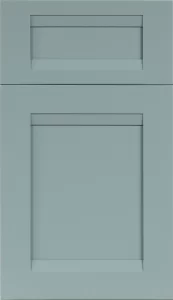
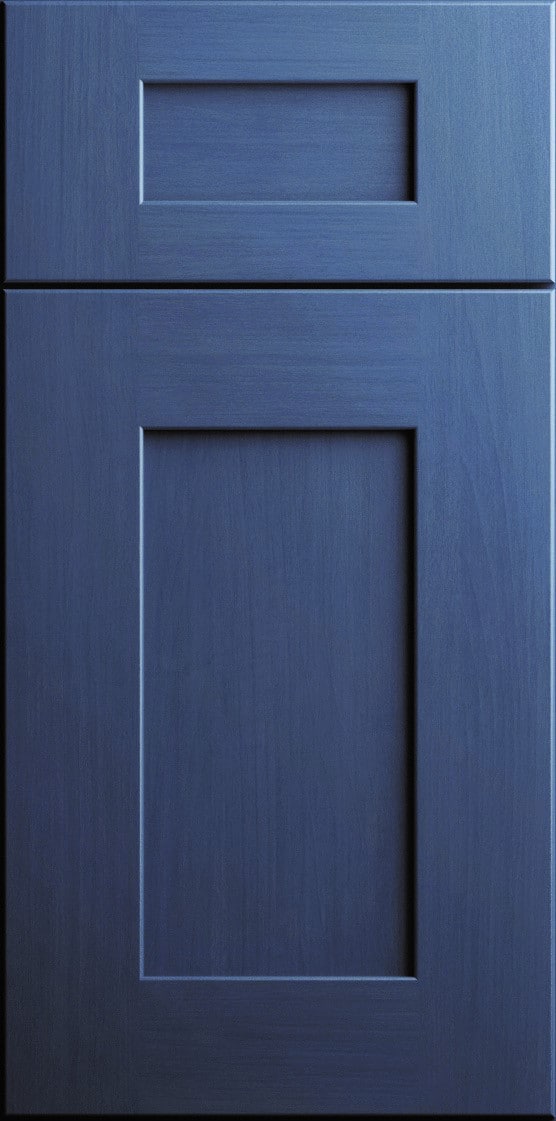
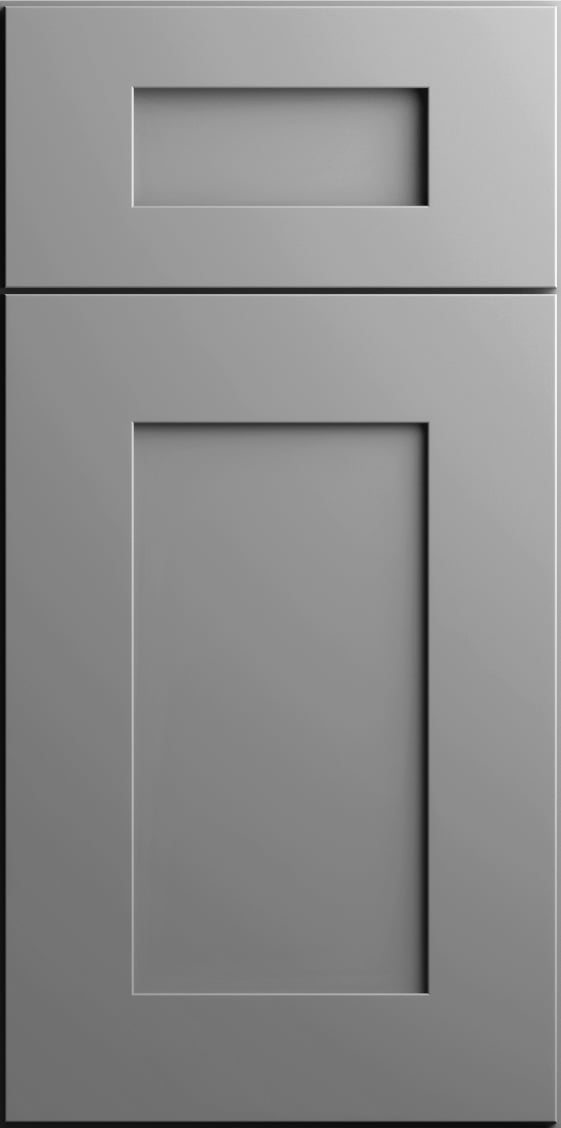
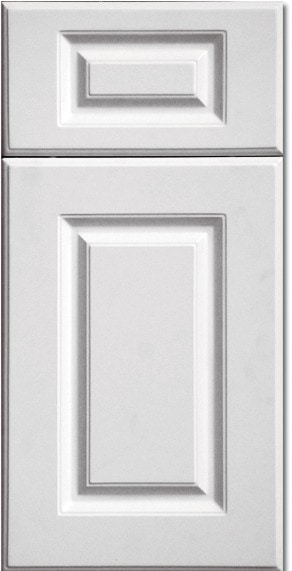
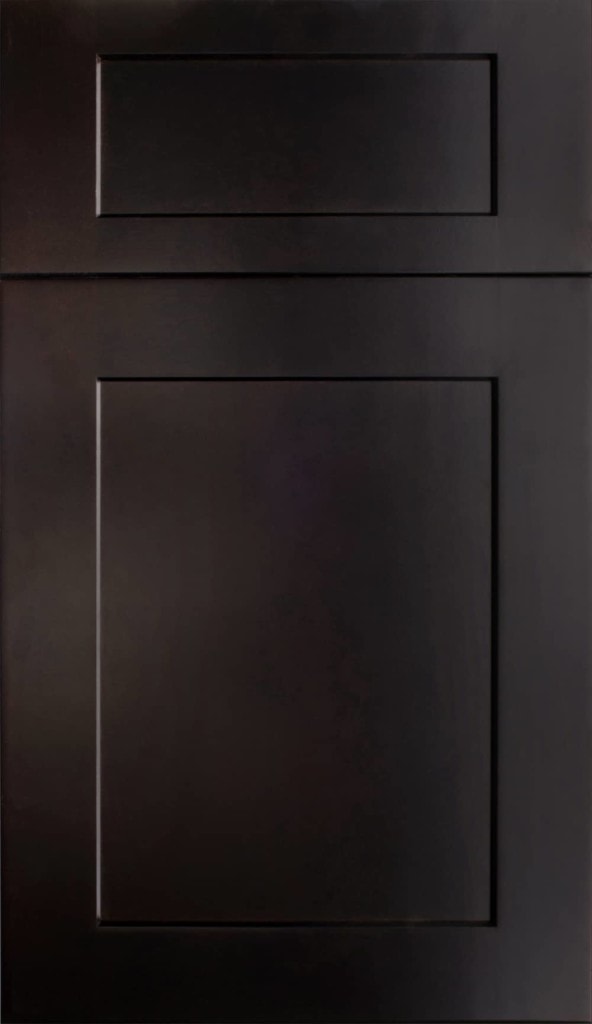
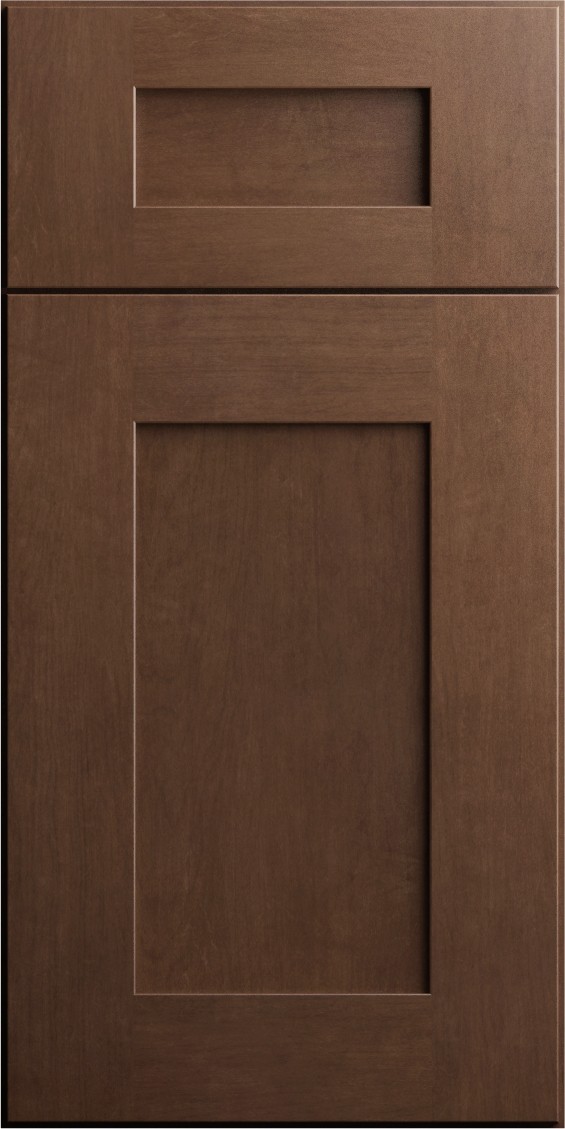
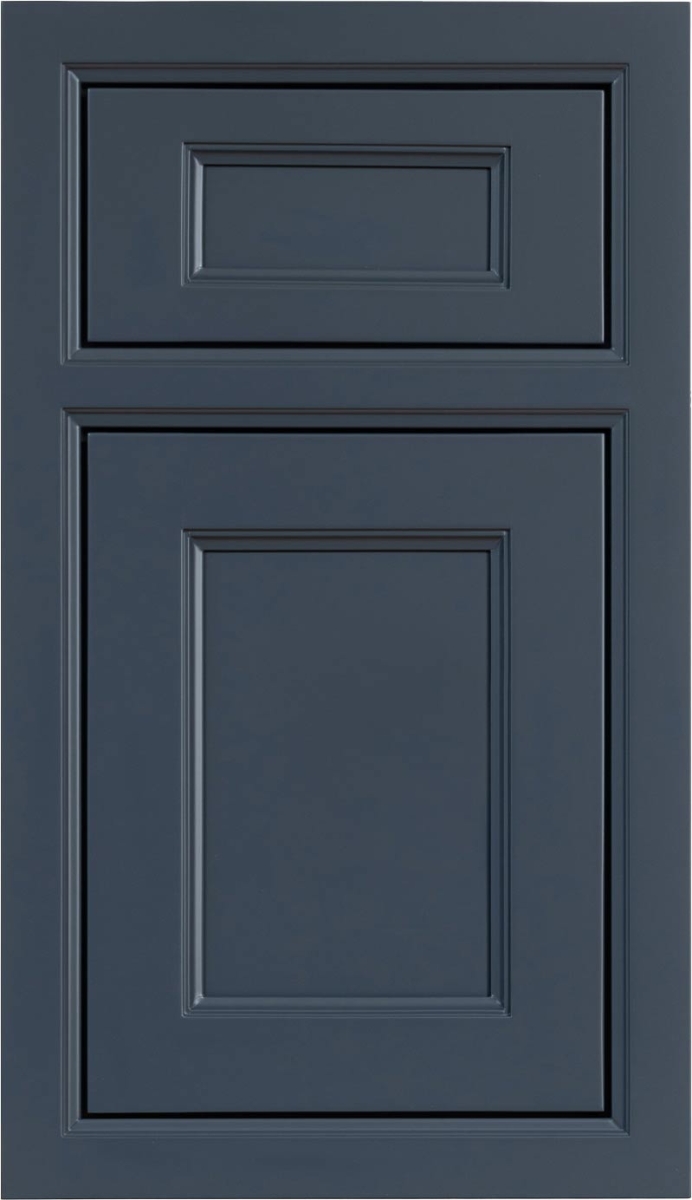
CUSTOM CABINET DOOR COLLECTION
Our cabinet door collection gives homeowners the flexibility to shape the visual character of their kitchen without compromising quality or durability. Through our design process, we curate a wide range of door styles—from timeless raised-panel designs to modern slab and versatile transitional profiles—allowing each kitchen to reflect the architecture of the home and the lifestyle of the homeowner. With a broad selection of finishes, colors, and textures available, cabinetry can be tailored to achieve the exact balance of style, performance, and long-term durability required for everyday living.
Every custom door is built with attention to detail and a wide range of finish and color options, allowing you to create cabinetry that complements your home’s architecture while maintaining durability for everyday use.

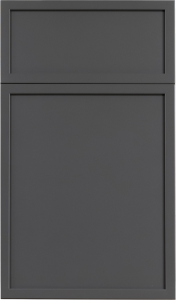
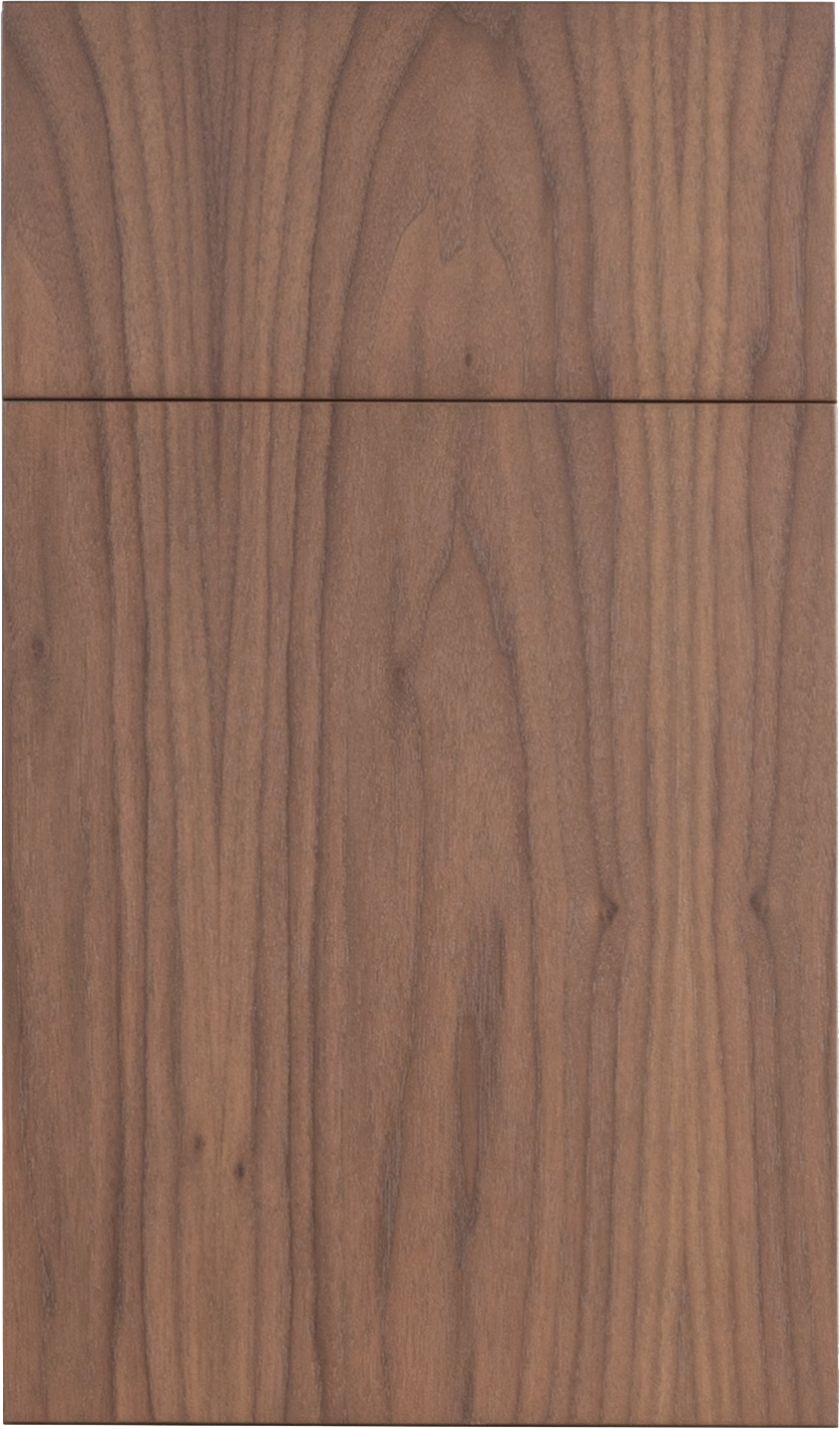
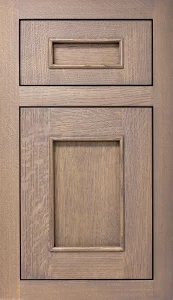
STANDARD CABINET EXPANDED DOOR COLLECTION
Quality cabinetry does not have to begin at the top of the budget. Our standard door collection brings together manufacturers we have vetted over years of real project experience — selected for their ability to deliver consistent results at an accessible price point.
Our Expanded Collection is the right fit when your design calls for something more specific — a particular color palette, a distinctive profile, or a finish that’s harder to source elsewhere. With a wider range of door styles, colors, and configurations, this collection gives your kitchen a more tailored, individual character. Because these cabinets are built with greater customization in mind, lead times run a few weeks out — worth planning for, and worth the wait.
Expanded Door Collection


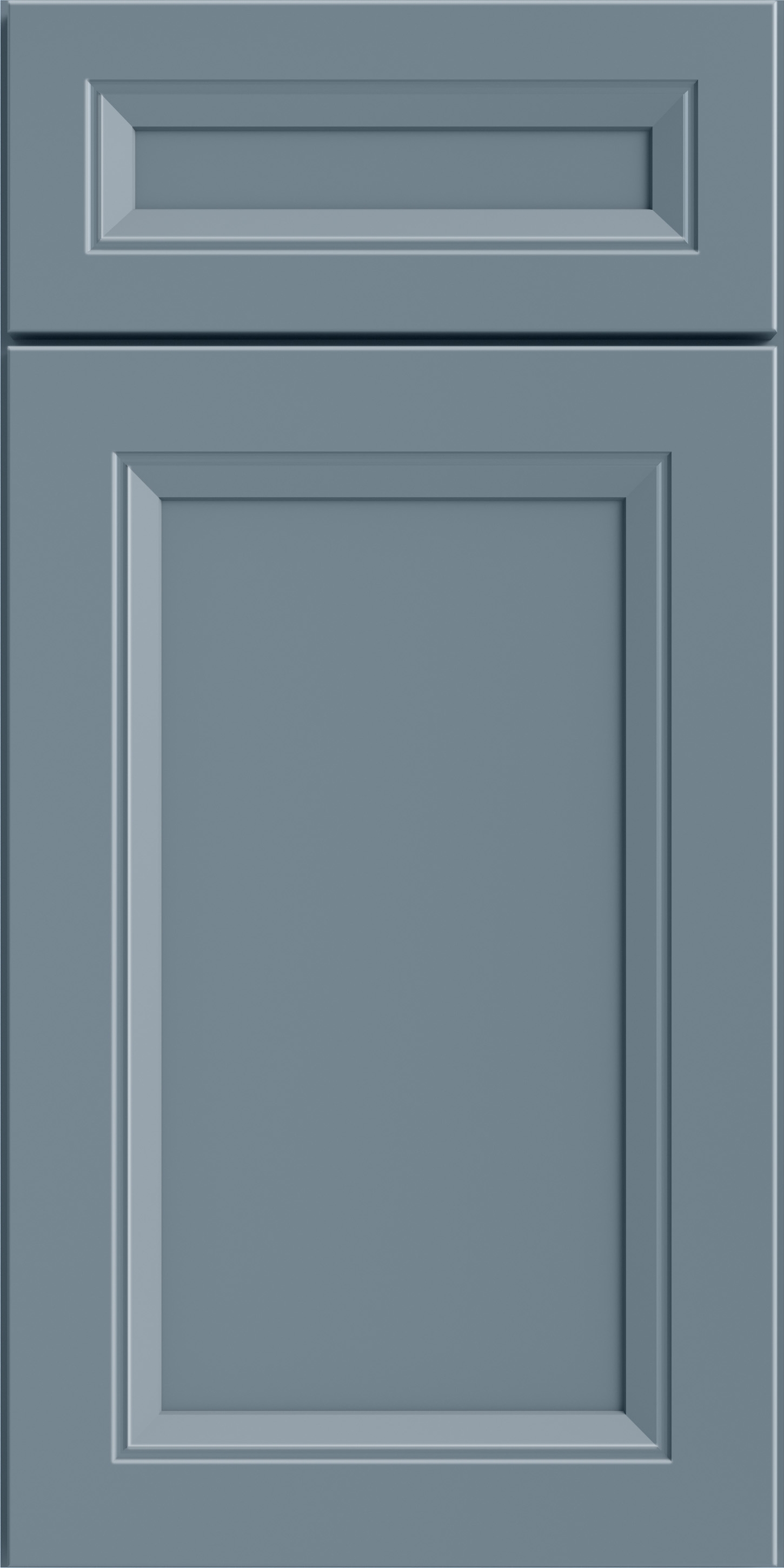
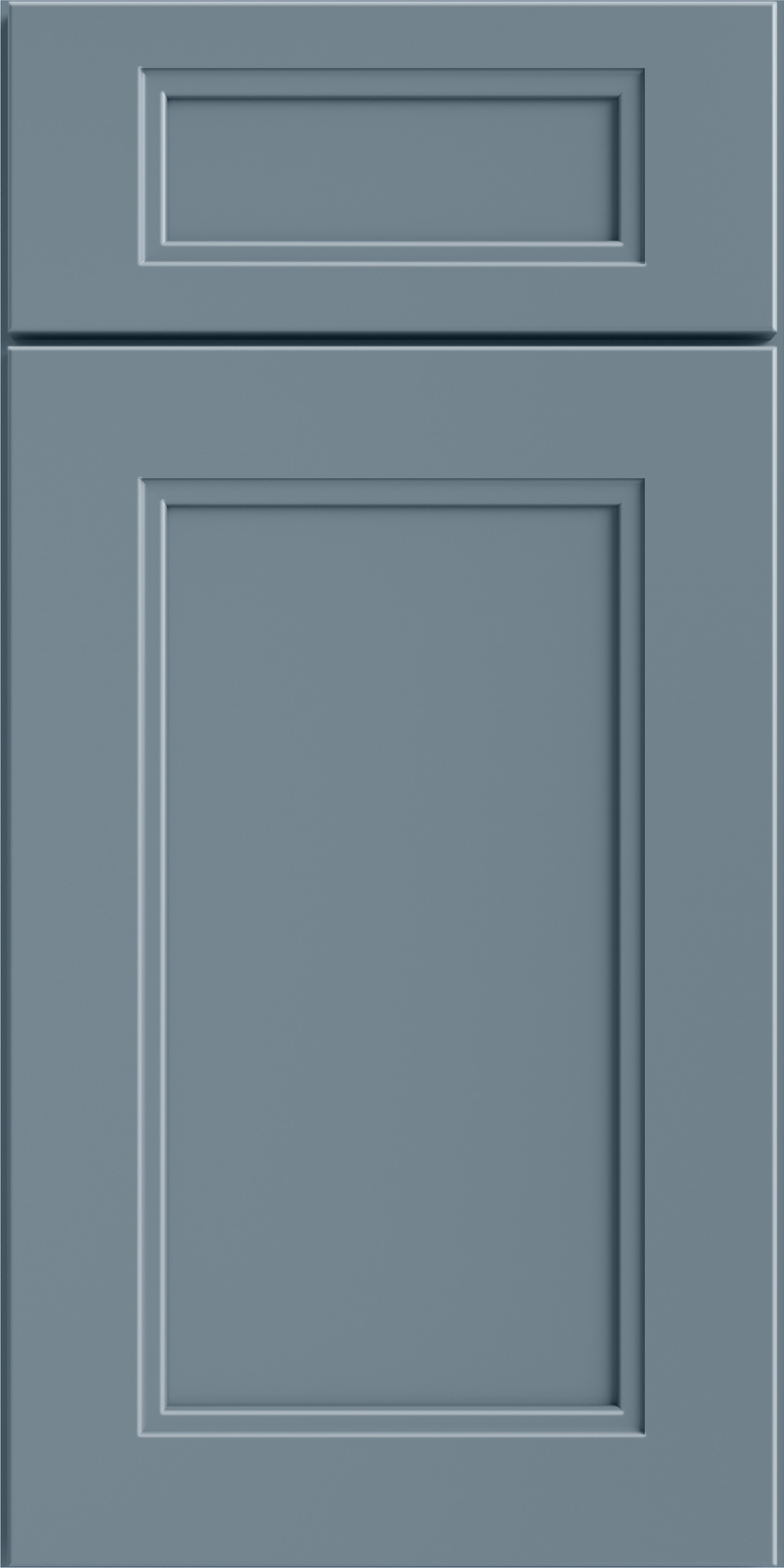
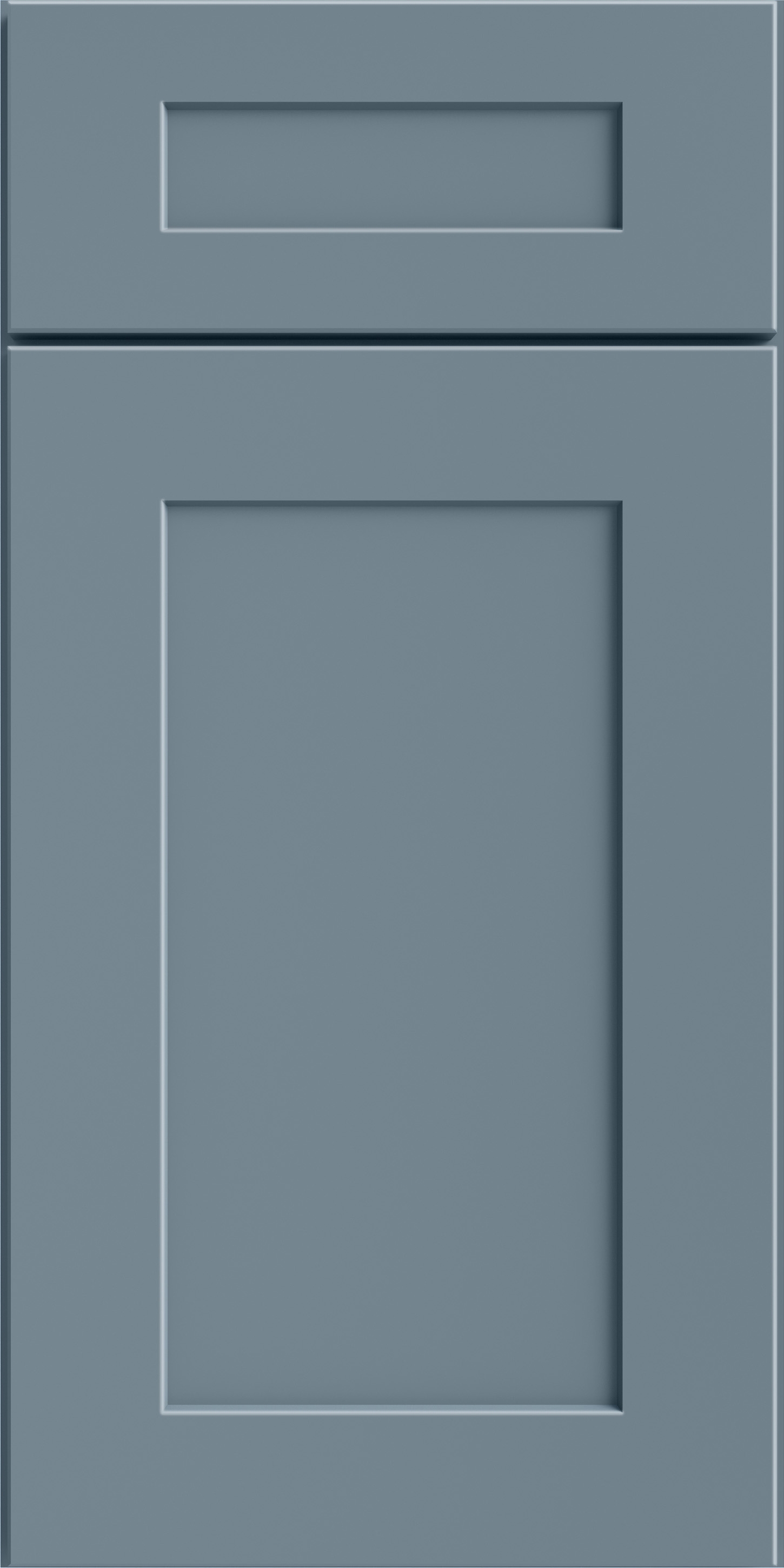
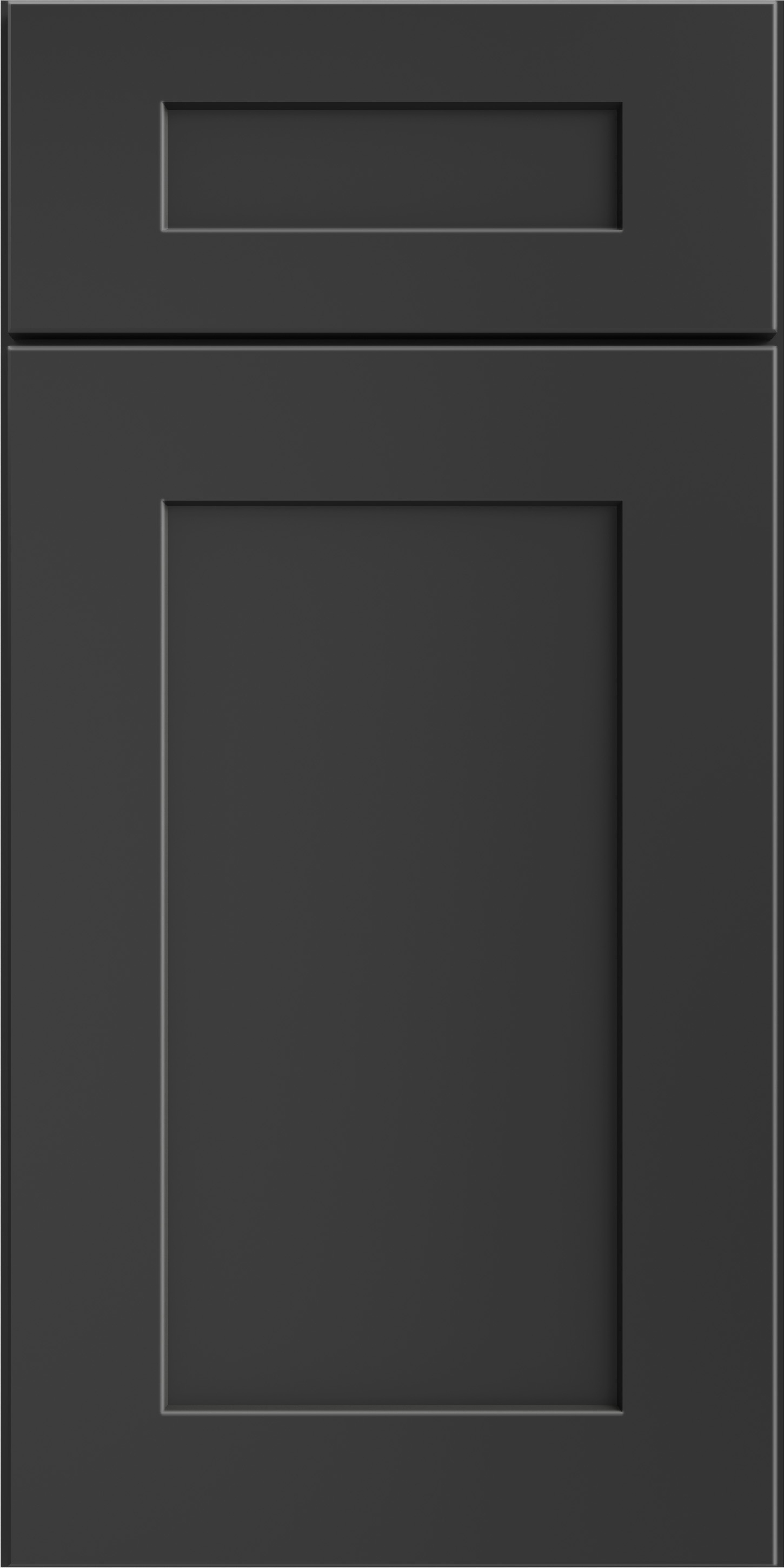
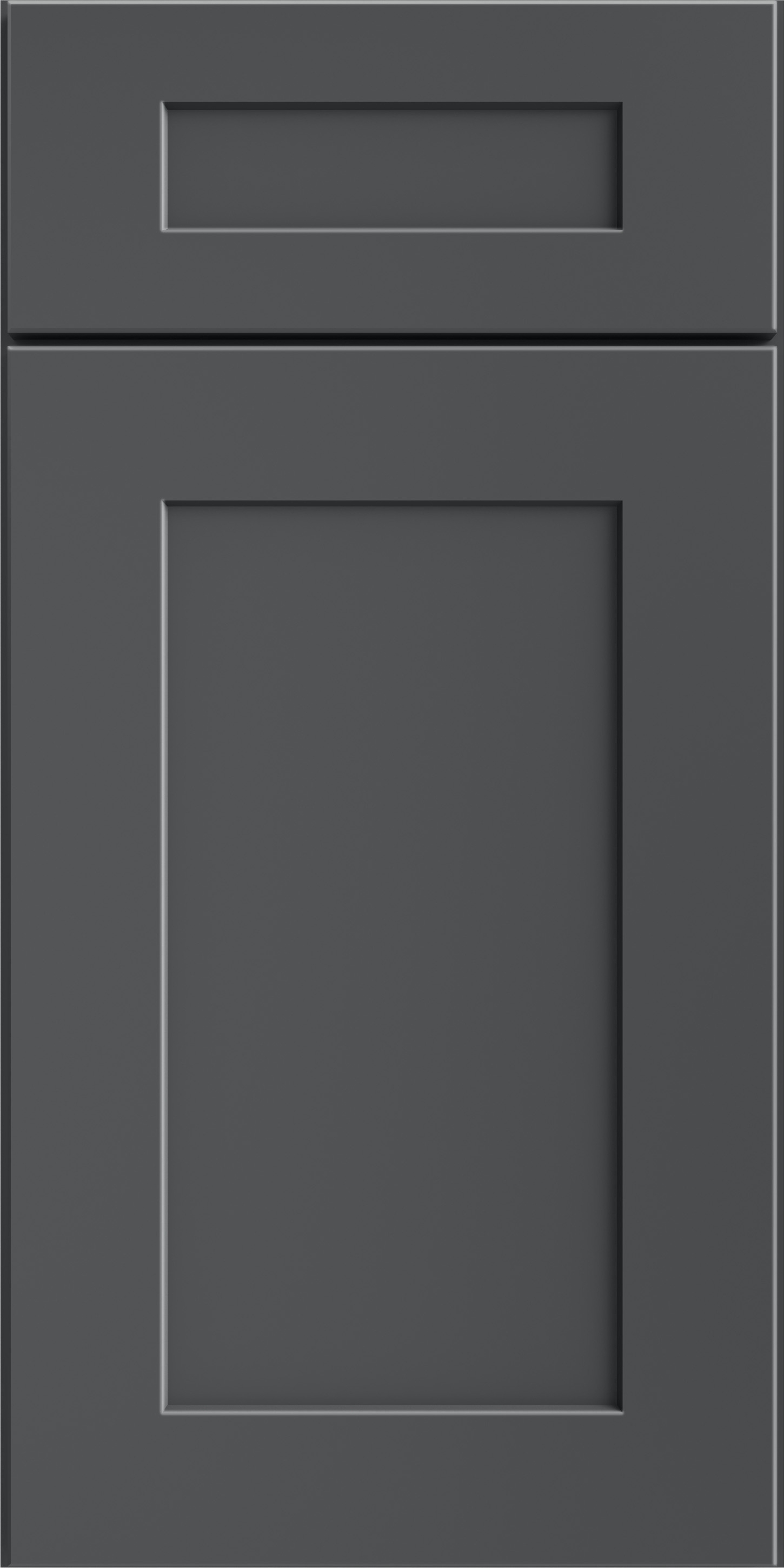
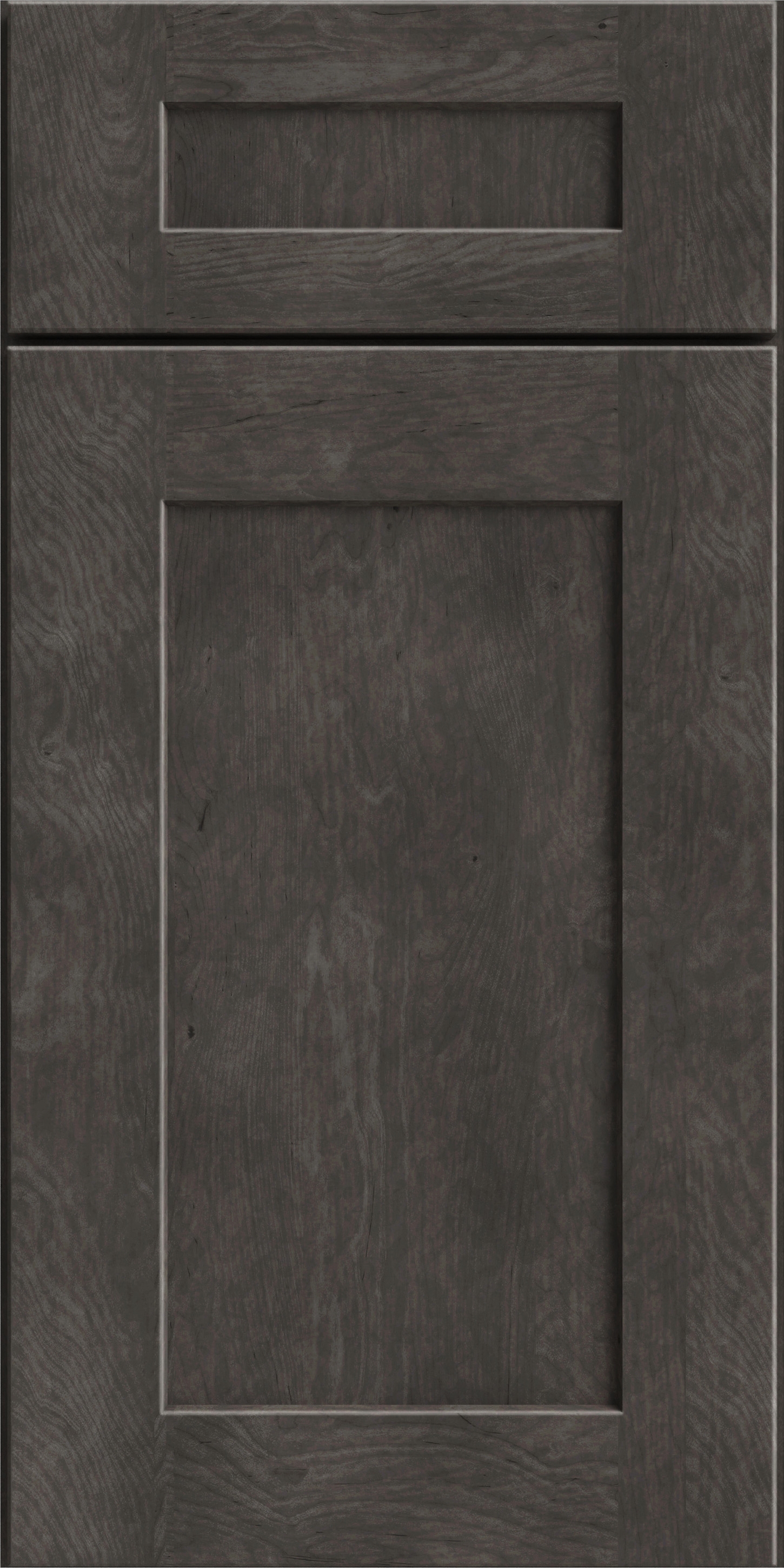

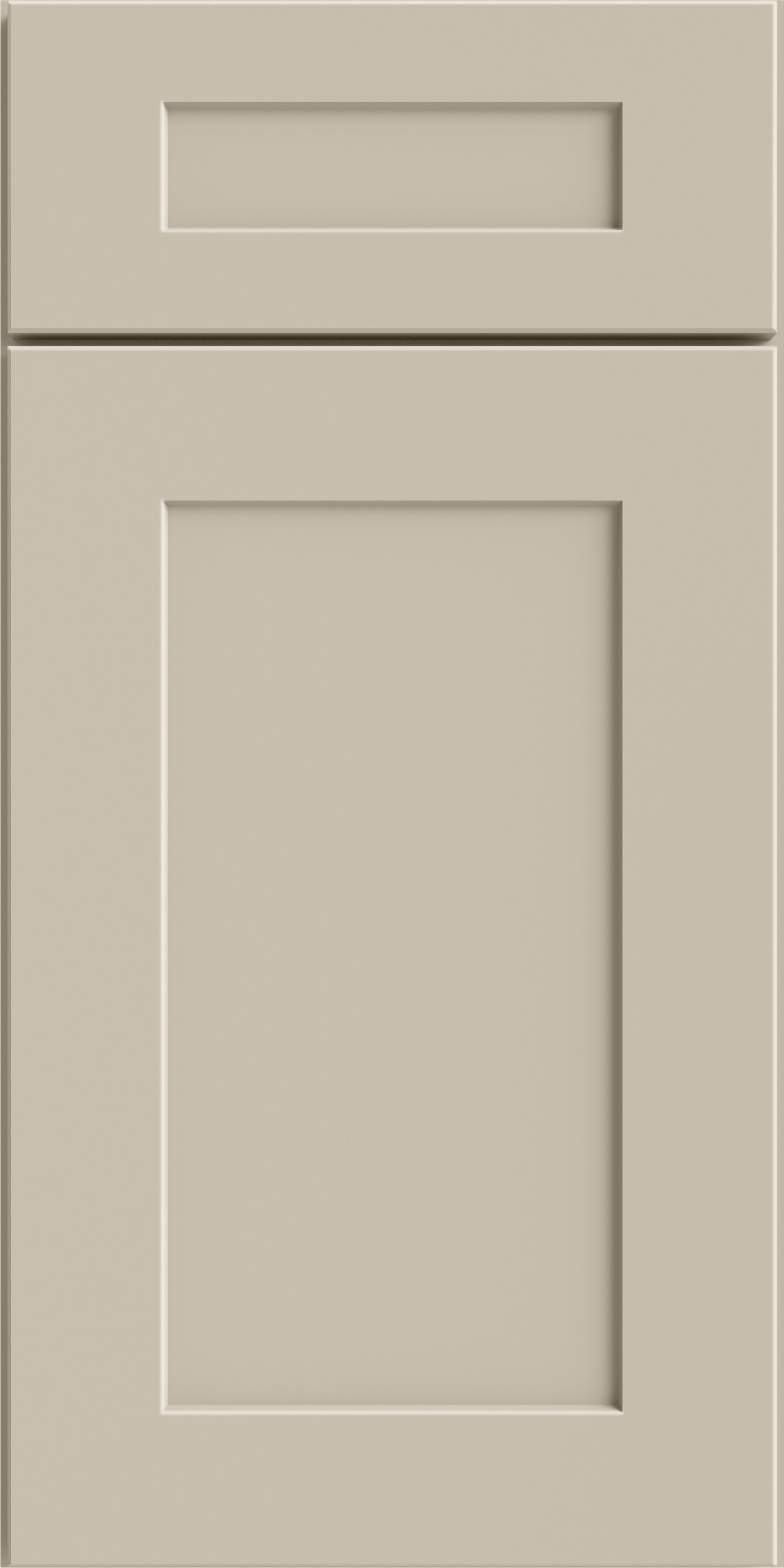
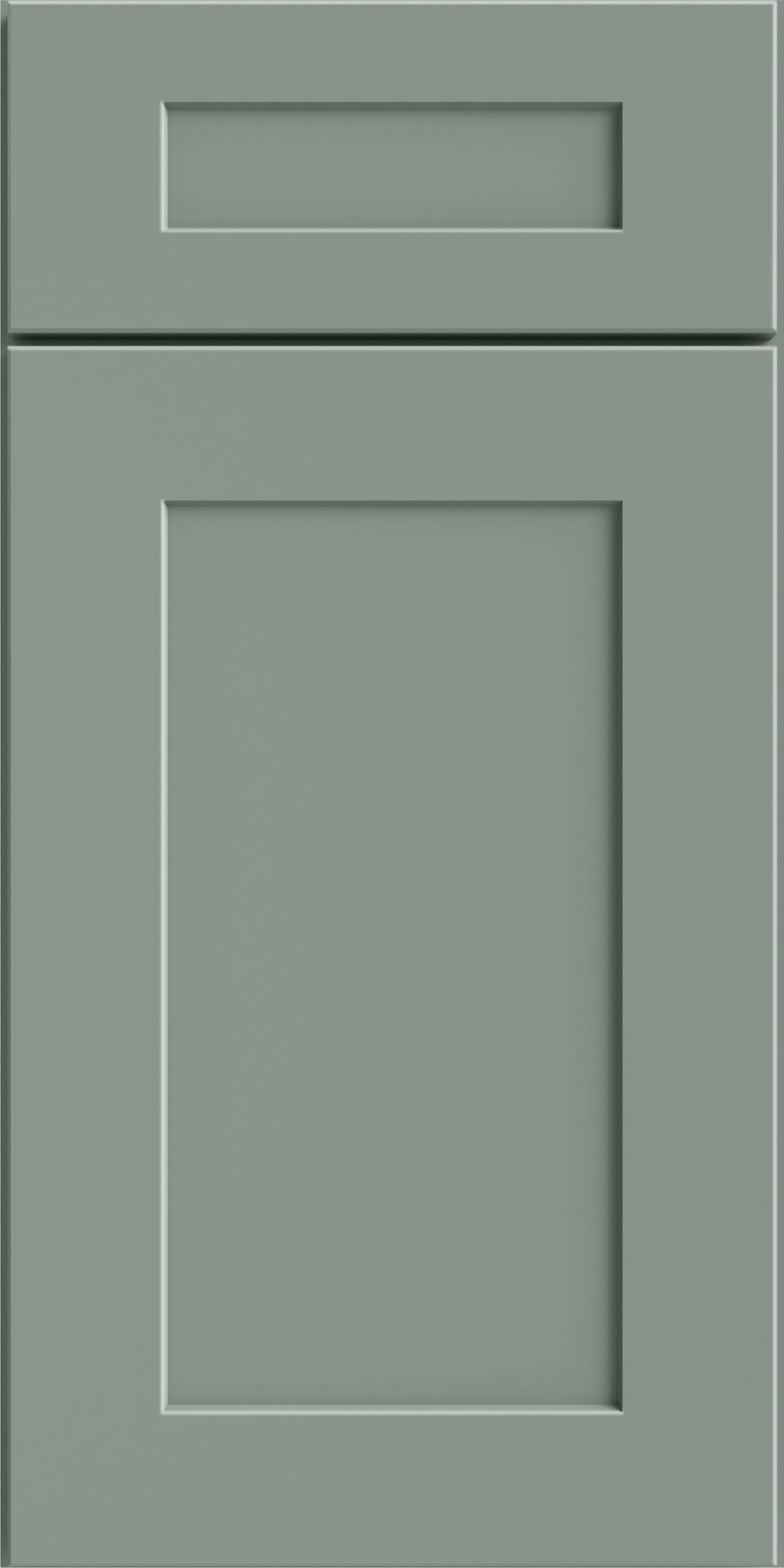

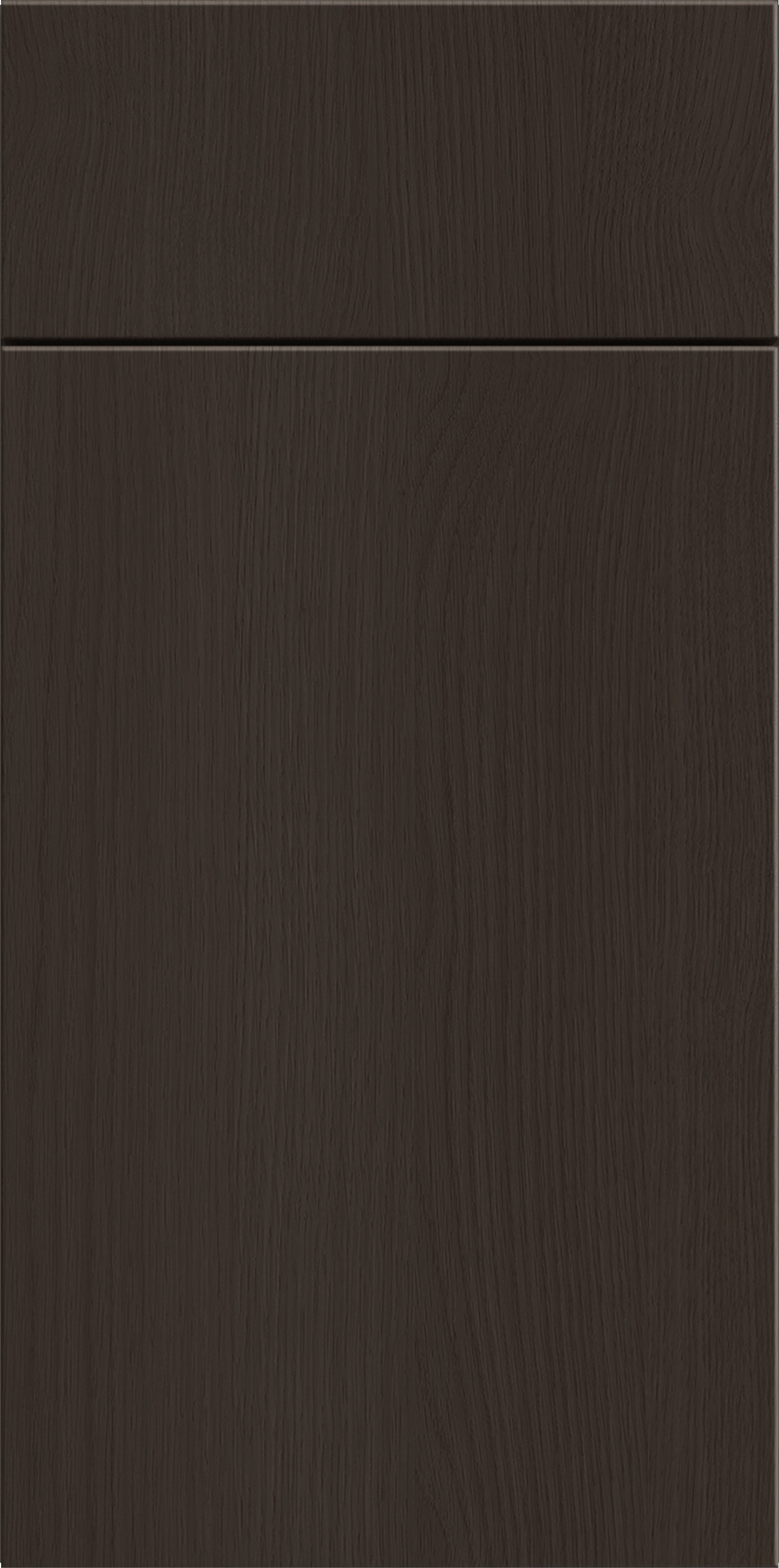
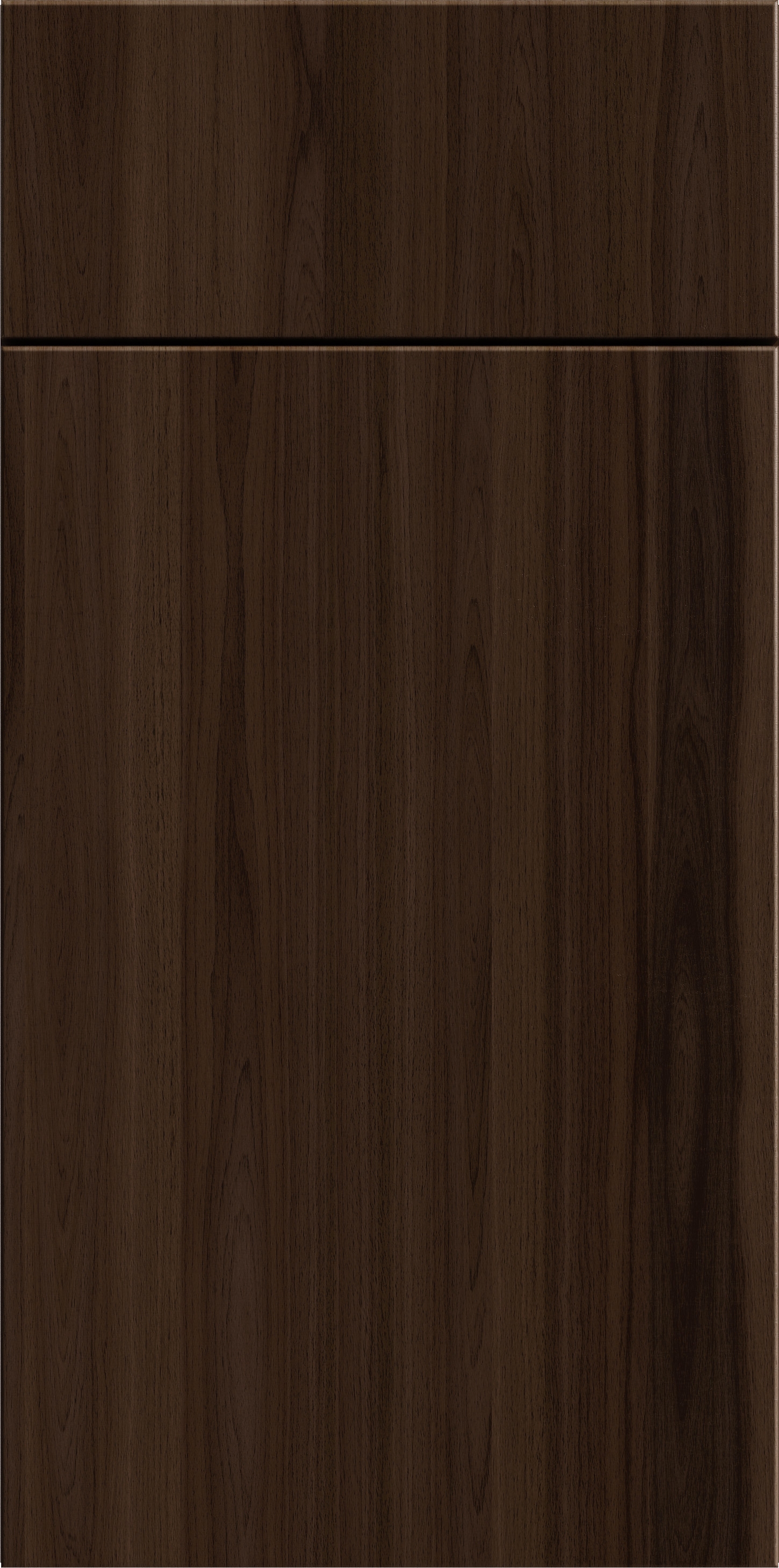
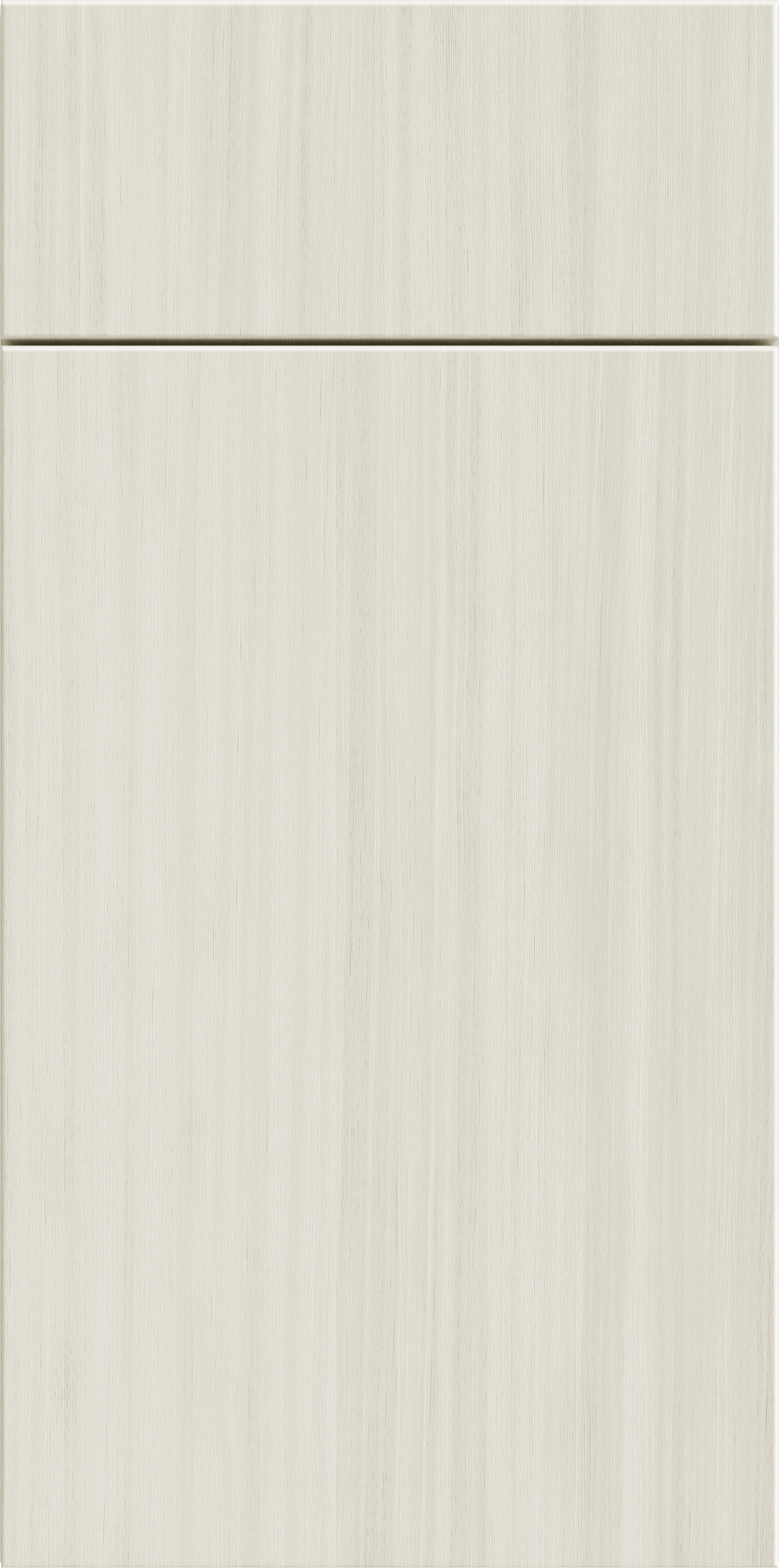




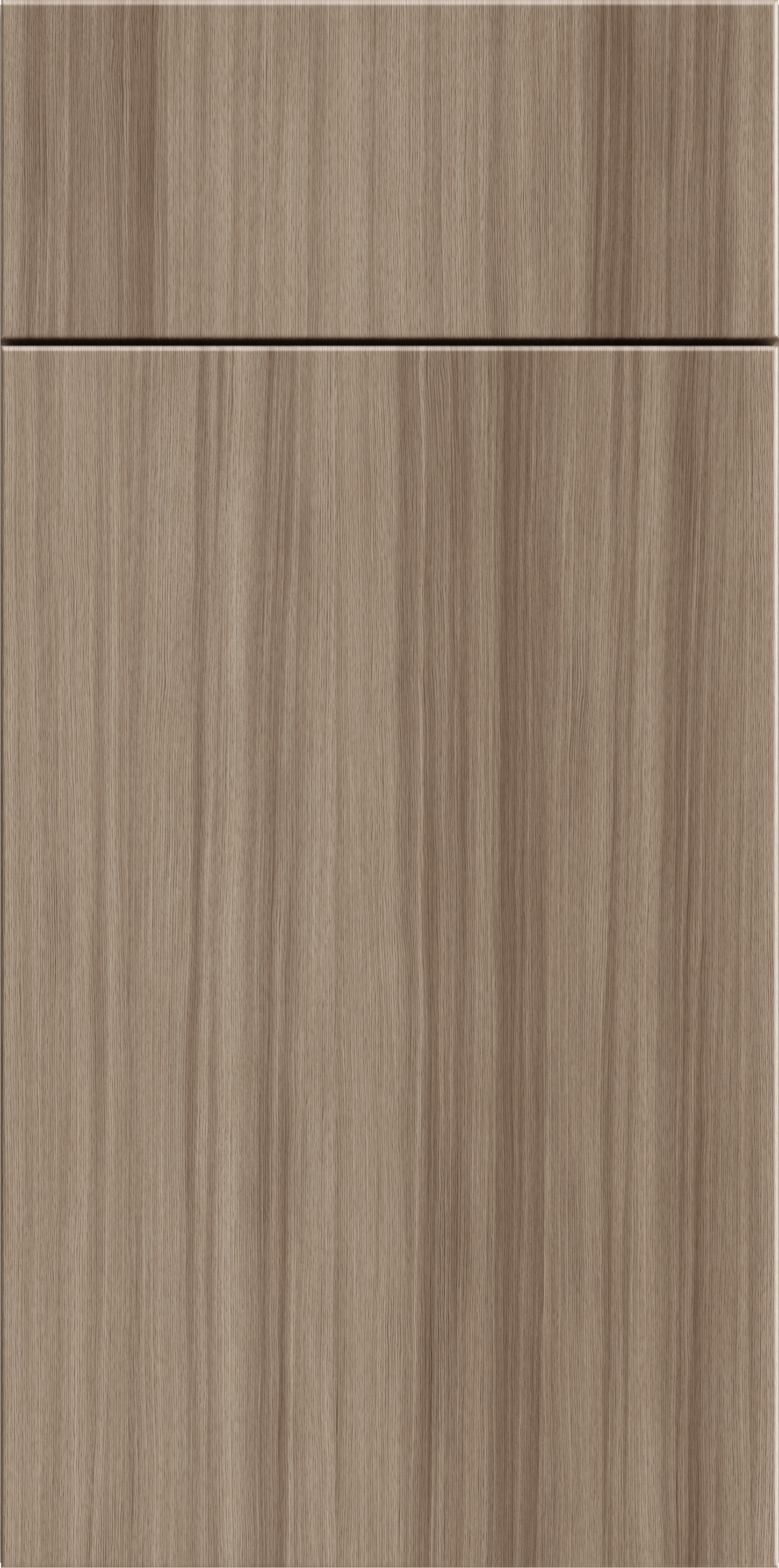
Our Curated Collection brings all-wood construction, certified sustainable materials, and low-emission finishes to the most requested styles in Westchester kitchens. It’s a strong fit when the design direction is clear and you want a proven, consistent product behind it — trusted by designers and contractors across the region for its reliability, quality, and quicker availability.
Curated Door collection
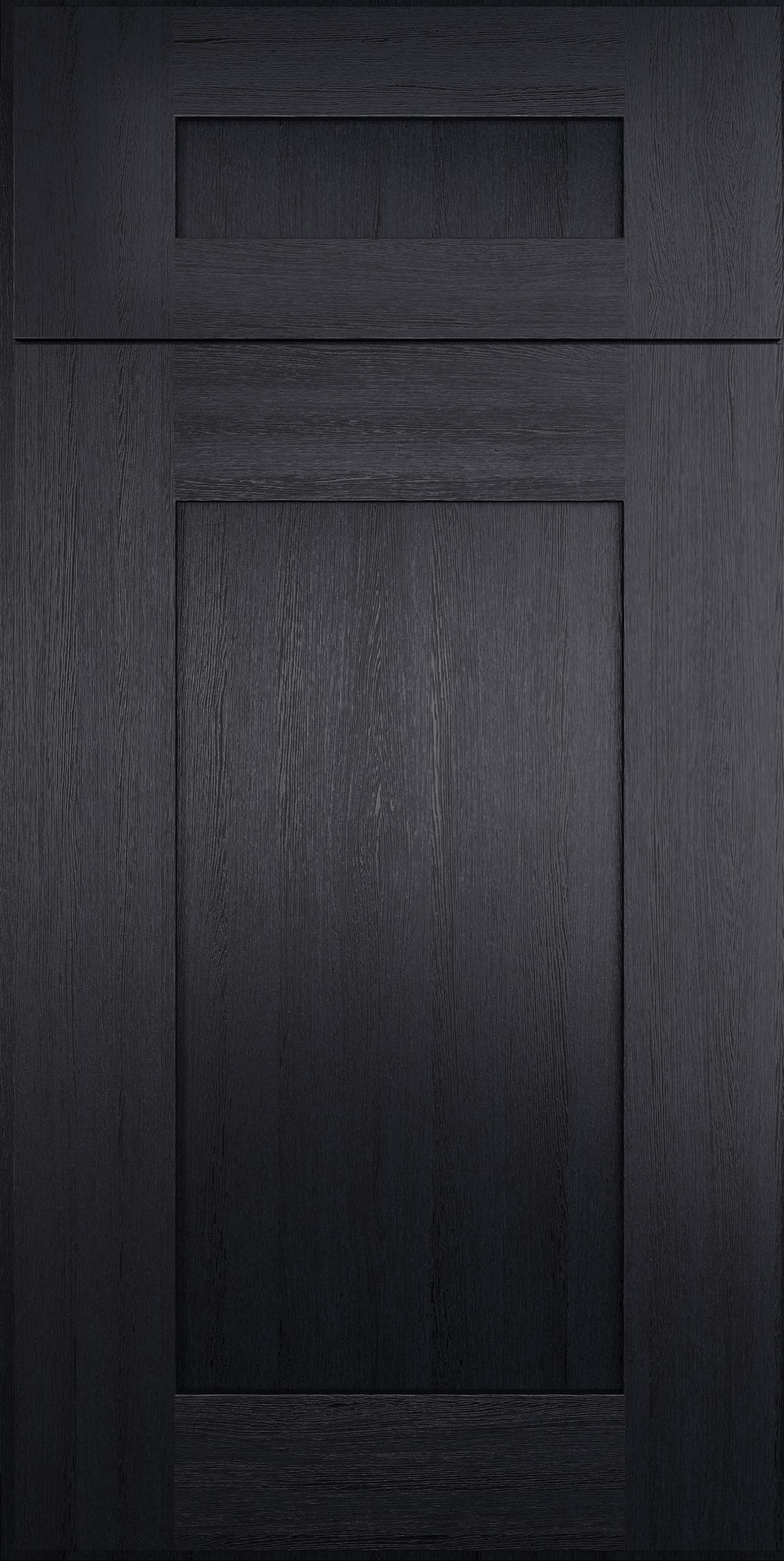
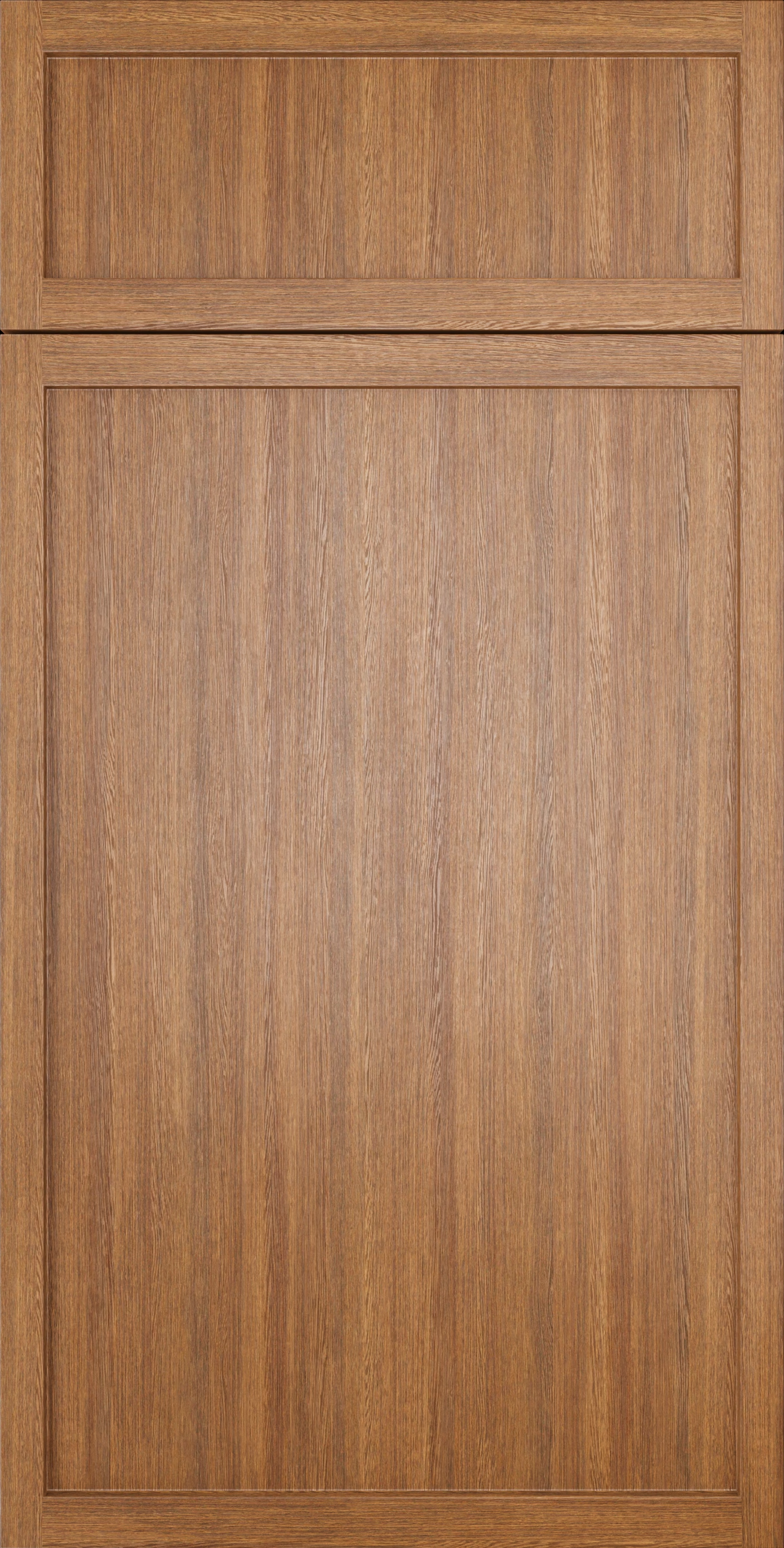
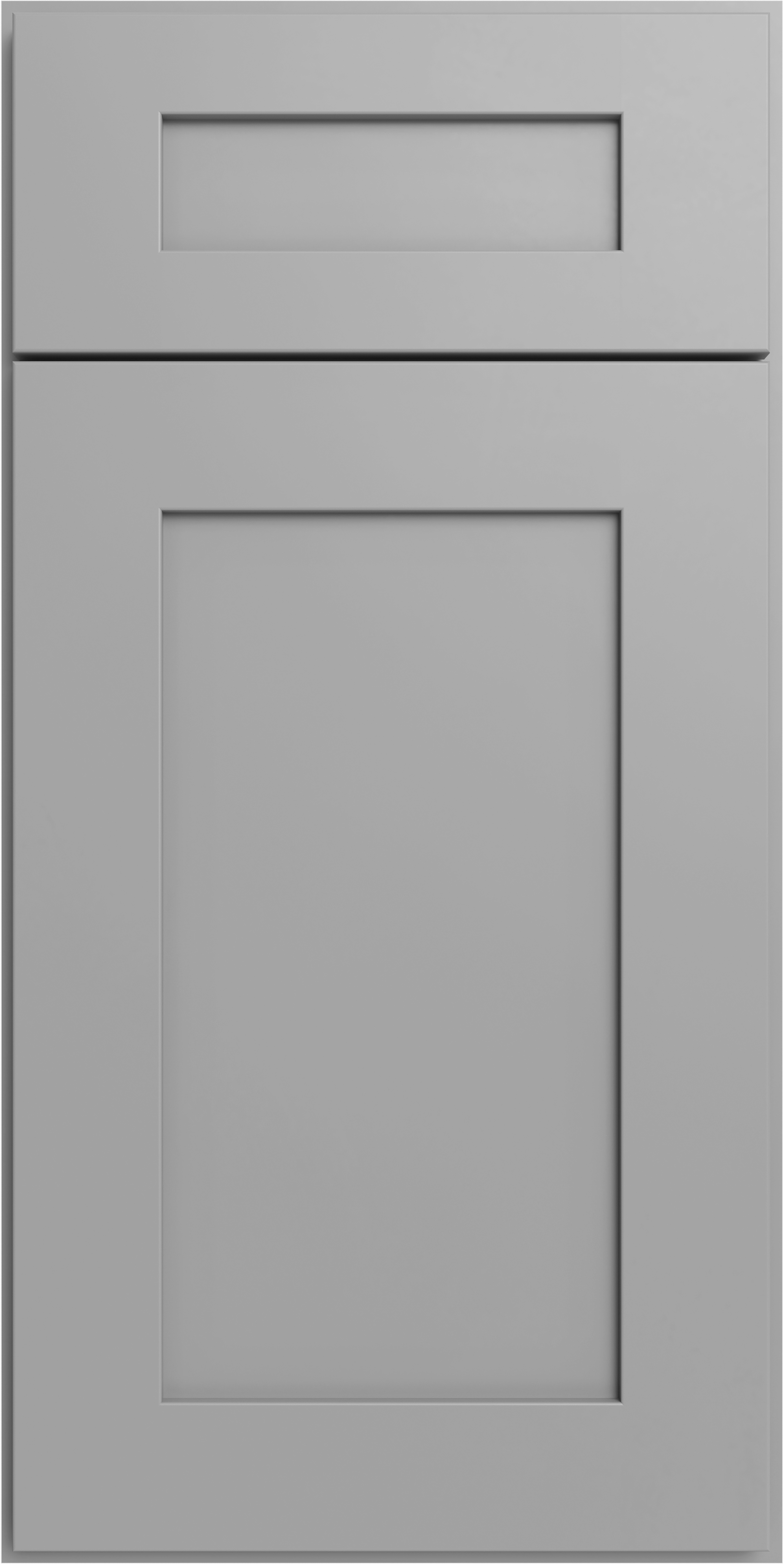
Door panels live in motion, especially in Northeast climates where humidity swings are real.
Well-built doors account for this. They typically include solid hardwood frames, center panels designed to float within the frame, moisture-controlled finishing processes, and reinforced hinge mounting.
Warping and cracking are rarely random — they usually trace back to material selection or insufficient finish protection.
For painted cabinetry, engineered center panels like MDF often provide greater stability and reduce visible movement at joints. For stained finishes where the grain is the feature, solid wood remains a beautiful and appropriate choice.
The goal is not dogma.
The goal is stability.
Surface Quality
These are the details people feel even if they cannot immediately explain them.
How smooth is the surface?
How consistent is the sheen from part to part?
How are inside edges handled?
How resistant is the coating to wear?
This is the difference between cabinetry that merely looks impressive and cabinetry that continues to feel right years later.
The Professional Role
At this stage, our responsibility is guidance.
Unlimited choice without structure usually creates confusion, not clarity.
So we narrow options.
We test combinations.
We compare scale.
We study how light will affect tone throughout the day.
And gradually, the kitchen finds its voice.
Closing
Cabinetry is a structural system — not a decorative afterthought. Material selection, joinery, hardware performance, and installation precision determine how well a kitchen will function years from now. Homeowners often begin with what they see. Professionals begin with what supports it. Because beauty lasts longest when it is built on the right foundation.
By now it should be clear that cabinetry is engineering, movement, and manufacturing discipline long before it becomes style. Door profiles, box construction, overlay relationships, hardware systems, and modification allowances influence layout, budgeting, and scheduling from the earliest days of a project. When these decisions are delayed, options narrow. When they are rushed, compromises appear. When they are addressed early, the renovation moves forward with clarity and control.
Cabinet orders are not easily reversed. Production begins. Materials are committed. Dimensions are locked. Changing direction later can mean added cost, lost time, or accepting something different than what was imagined.
This is why experienced planning matters.
The goal is not simply to choose cabinets.
The goal is to choose correctly, at the right moment, with a full understanding of how those choices shape everything that follows.
When cabinetry is resolved early and intelligently, design becomes sharper. Budgets become more predictable. Installation moves more smoothly. Stress decreases for everyone involved. Kitchens that feel effortless at the end are rarely accidental — they are the result of informed decisions made early, guided by people who understand what is at stake.
If you are beginning to think about cabinetry for your home, this is the moment to start the conversation.
Where Great Projects Begin
The best renovations rarely start with materials.
They start with alignment — between design intent, technical reality, budget, and long-term performance.
Our responsibility is to help homeowners make those decisions early, with clarity and confidence. Through careful planning, specification guidance, and real-world experience, we ensure the cabinetry system supports the home beautifully for years after installation.
When that groundwork is done correctly, the entire project moves with greater control. Stress decreases. Surprises reduce. Results improve.
If you are beginning to explore cabinetry for your home and want experienced guidance before options narrow, we invite you to start the conversation.
Great cabinetry decisions are rarely rushed. They are developed through careful evaluation of space, architecture, performance needs, and long-term goals. The earlier these conversations happen, the more options remain available and the stronger the final outcome becomes.
READY TO START PLANNING?
Every great kitchen starts with one conversation.
We'll help you understand exactly which cabinet system fits your home, your design intent, and your investment — before any decisions are locked in.
SCHEDULE YOUR CONSULTATION →Serving Westchester County since 2015 · Licensed & Insured · 914-888-7668